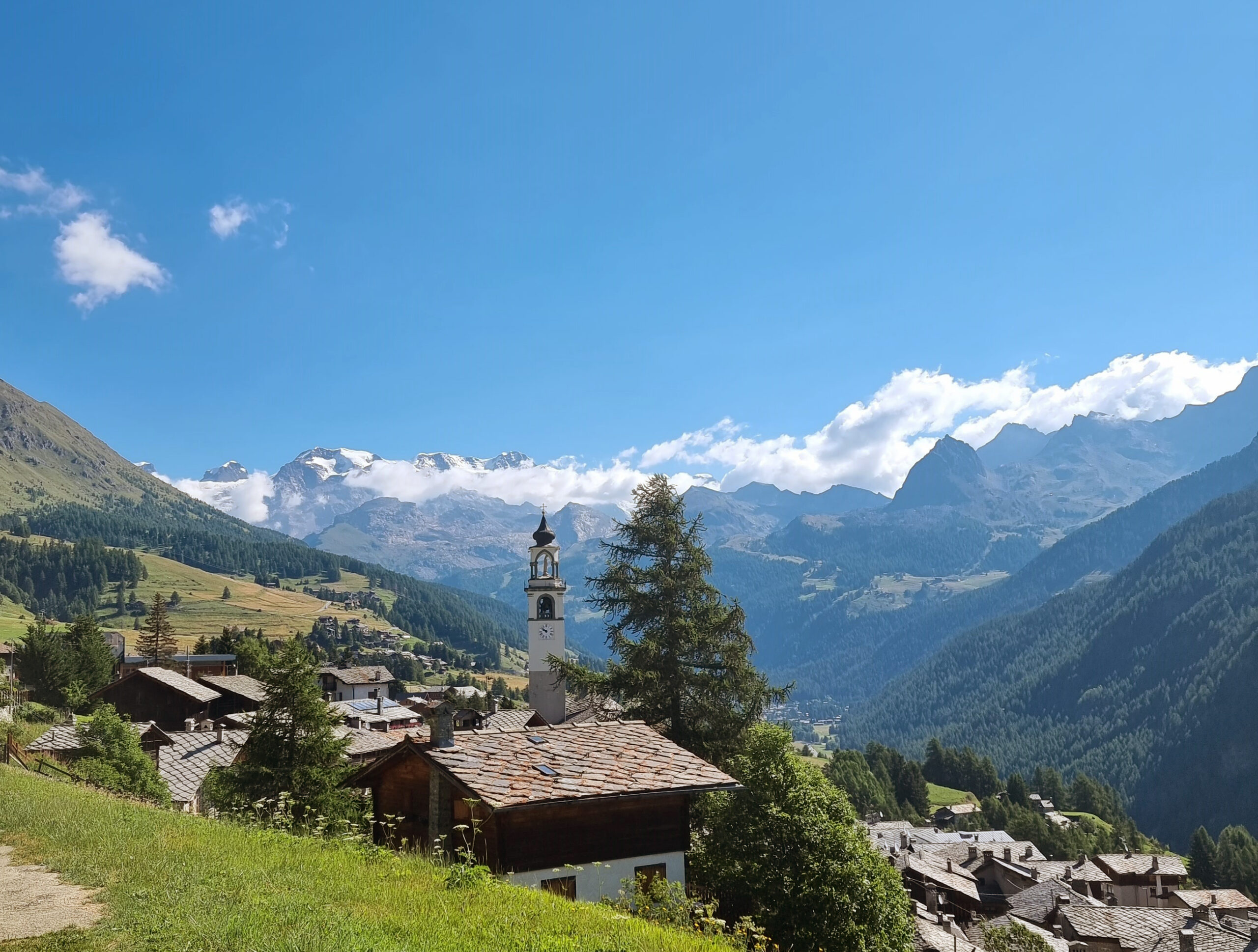
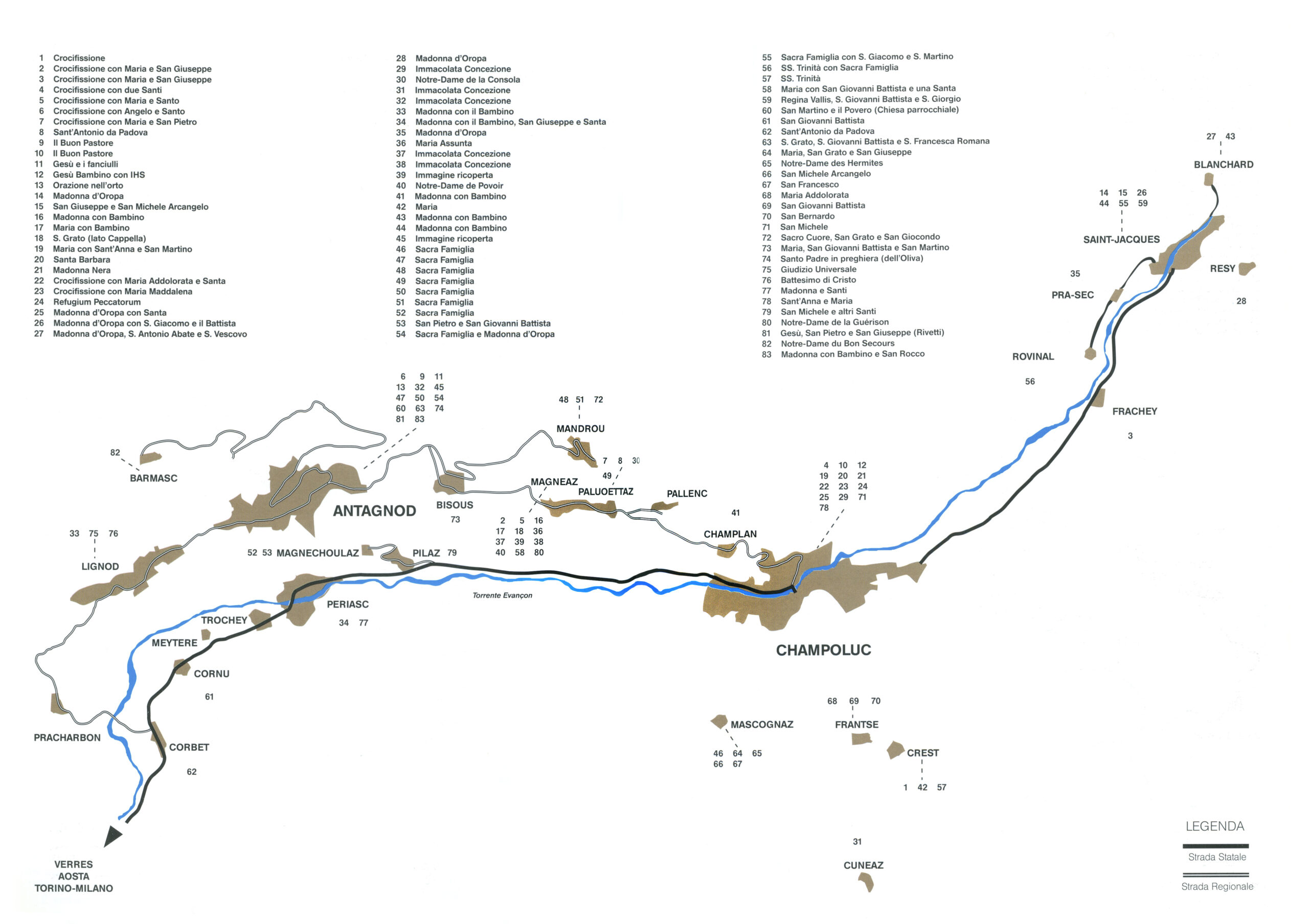
In addition to the ancient church of Antagnod, dedicated to Saint Martin, and the new church of Champoluc, the Ayas basin is particularly rich in chapels, rural shrines, oratories, and devotional images.
Like the major sacred buildings, the minor ones are also characterized by a wealth of imagery and bear witness to the widespread function of the sacralization of space that they exercised in past centuries.
Since the early Middle Ages, the ties between the upper Evançon valley and the Church were very close. From 516 to 1728, this area belonged by right to the Abbey of Saint-Maurice d’Agaune in nearby Valais, with the interposition from 1263 to 1728 of the noble Challant family as feudal lords who exercised not only political but also religious power over the territory, having high-ranking ecclesiastics among their members.
The presence of a strong local clergy, linked in part to civil authority, then contributed between the 18th and 19th centuries to the flourishing of religiosity in Ayas and to the most diverse manifestations of sacred art, both official and private.
In particular, the process of development of places of worship received a strong boost in the 18th century thanks to three prominent local ecclesiastics, the three ‘Prévôts’, Joseph Raymond (1688-1749), Jean-Jacques Duc (1705-1762), and Jean-Pierre Dondeynaz (1721-1802) and, in the following century, thanks to the action carried out by the parish priest François Victor Amé Dandrès, who led the parish of Ayas from 1817 to 1866 and who promoted the construction of new places of worship, as well as the restoration of those in ruins.
The prevailing subject of sacred iconographic themes is the Virgin Mary, indicating the greater demand for protection and intercession from the local populations. Mary is represented under various titles, the most frequent of which are those of the Black Virgin of Oropa and the Immaculate Conception.
A very recurring theme is the Holy Family, particularly developed in the second half of the 19th century by the painter Franz Curta. Finally, there is no lack of representations of the death of Christ, which connects to other minor signs of the sacred present in the territory, such as the Calvaries, carved on the doors of houses, and the Crosses, placed along paths and on mountain peaks. Representations of Christ under the title of the Good Shepherd, or of other ‘Alpine’ saints, such as Saint Martin, Saint Gratus, Saint Bernard, of ‘powerful’ saints against evil, such as Saint Michael and Saint John the Baptist, and of other ‘thaumaturge’ (miracle-working) saints, such as Saint Anthony Abbot, Saint Anthony of Padua, and Saint Roch, constitute much of the Pantheon of protectors and intercessors that popular devotion once required from the anonymous authors of sacred images.
Sacred images in the urban landscape
The votive and devotional images frequently found today in non-sacred settings (private buildings) served not only a symbolic protective function but were probably also intended both to contain the reformist influences spreading from nearby Valais (in present-day Switzerland) into the upper Evançon valley and to maintain strong ties between the official Church and a community at the head of the valley, such as that of Ayas.
Bibliography
L.Capra, G.Saglio, Immagini di devozione popolare nel territorio di Ayas. Pitture murali su abitazioni, cappelle e oratori, dal XVI al XX secolo in un Comune della Valle d’Aosta, “Quaderni di cultura alpina”, Priuli & Verlucca editori, Aosta, 1993