Les Fusines Li Fejeune – 1.700 m Blanchard Biantchart – 1.724 m Rovinal Rovénal – 1.709 m Praz-Sec Pra-Sec – 1.700 m Les Péyoz Li Péyo – 1.725 m Les Droles Li Drole – 1.757 m Bernosin Bernozìn – 1.750 m
This small settlement in the upper Val d’Ayas would seem to derive its name from the Latin pilare, to pound, indicating the presence of millstones and crushers, but also from the chaff removed from barley.
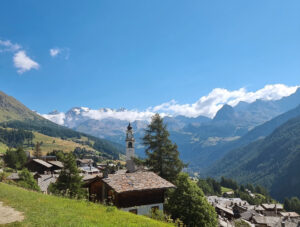
Pilaz (Pila in patois) is characterized, in its upper part, by fine ancient stone and wooden houses clustered around the Chapel of Saint Michael the Archangel (1746).
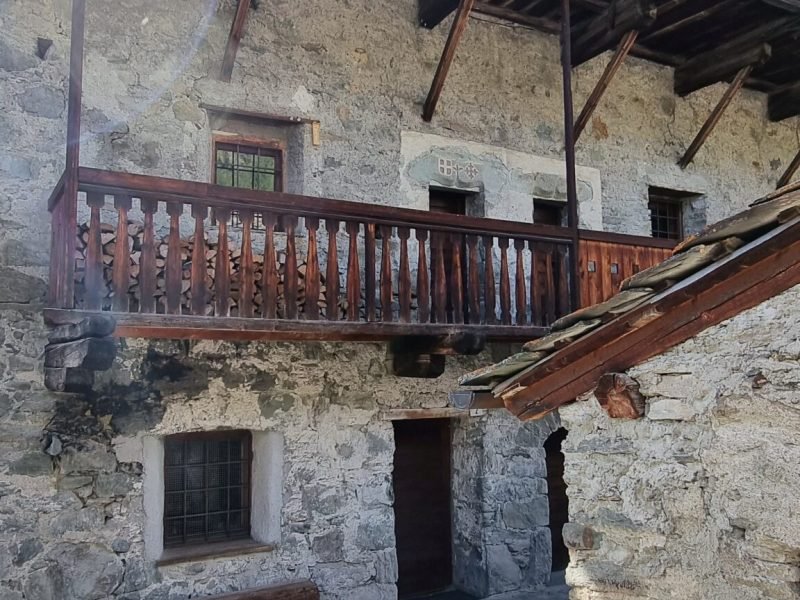
Here too, as almost everywhere, the main beams are like identity cards revealing the date of the buildings (with examples predating the 17th century) and the names or initials of the owners. Wandering among the typical examples of Aosta Valley architecture (multifunctional houses and rascards), one notices sundials and painted coats of arms, windows with lintels shaped like an overturned ship’s hull, and imposing arched gateways.
Pilaz had a mixed school, opened by Auguste Clos (1835–1909), parish priest of Ayas, and, like all self-sufficient villages, it possessed a mill, a cooperative dairy, and an oven.
At the foot of the settlement, near the course of the Evançon, there once extended a truly cutting-edge industrial area, active until the 1990s, with a mill-sawmill and an attached hydroelectric power station. Here, thanks to the power of water, electricity was produced and distributed to the nearby villages, cereals were ground, woolen fabrics were fulled to produce drap, and timber was sawn.
Map of Pilaz
House with concentrated functions
Dendrochronological analysis carried out on numerous samples taken from various parts of the large house has yielded extremely interesting results: it dated the felling of the larch used for internal beams to the autumn-winter of 1492/93, that of the larch for the ridge beam to the autumn-winter of 1577/78, that of the spruce for pillars and joists to 1581/82, and other parts to after 1702/03. The presence of the House of Savoy coat of arms on the lintel, shaped like an upturned ship’s hull, at the entrance to the first floor attests to the wealthy owner’s connection with the Savoy administration.
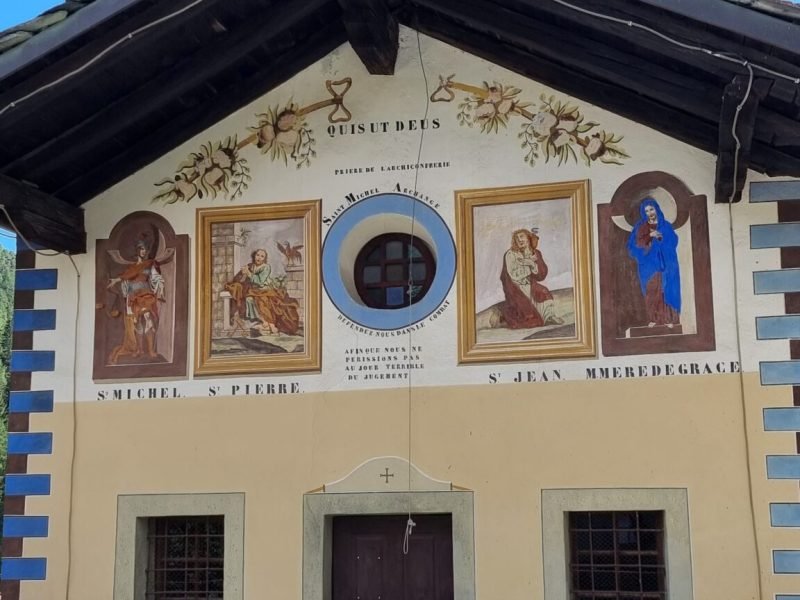
Chapel of San Michele Arcangelo
The ancient chapel, originally dedicated to Saint Peter in the 17th century, has been dedicated since 1746 to Saint Michael the Archangel, prince of the heavenly hosts and defender against the devil’s wickedness, whose feast day is celebrated on 29 September. On the façade, on the left, are depicted St Michael in warrior’s garb with his sword and scales, and St Peter with the keys to the Kingdom of Heaven; on the right, St John the Evangelist and the Virgin Mary under the title of MERE DE GRACE.