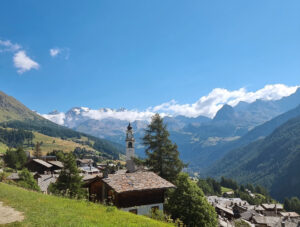
The historic part of the village lies to the right of Regional Road 45 and preserves examples of sturdy houses and ancient wooden rascards with stone foundations, while on the opposite side, in the wide fields, modern villas have been built. Further on, toward the west, a bridge provides access to the road running alongside the Evançon, which, passing through Meytéres and Le Trochey, reaches Périasc.
In the past, the forests stretching east of the settlement were used, in the lower area, for cultivation and still show remains of stone walls as well as traces of houses immersed in the vegetation.
Mount Zerbion and Portolaz Pass dominate the landscape.
It took several centuries for the communities of the “Cantone” of “Ultra Aquam” to evolve from isolated farms into actual villages, and Le Cornu reached its most vibrant period in the 19th century with the construction of the Chapel of Saint Bartholomew in 1818, completed by the parish priest of Ayas, François Victor Amé Dandrès (later fallen into ruin and rebuilt in 1937 in nearby Meytéres), and of a small school in 1885 on the initiative of parish priest Clos.
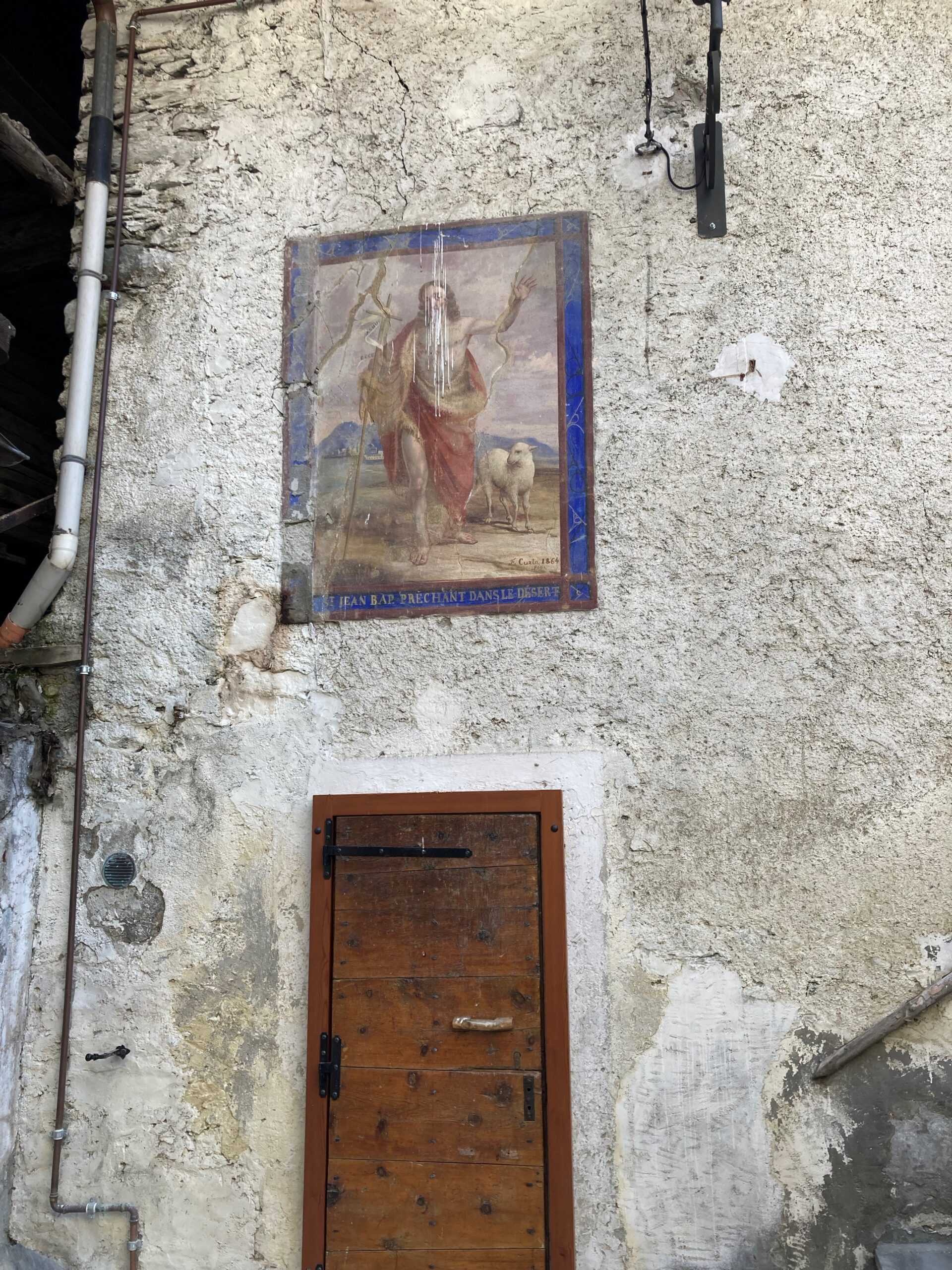
Here too, the well-known Aosta Valley painter Franz Curta left his mark by painting, in 1864, Saint John the Baptist Preaching in the Wilderness on the wall of a house (Casa Alliod Ballin).