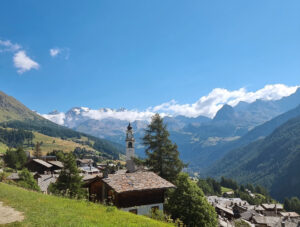
Perched on several levels along a grassy slope, just above France, and characterized by a spectacular view over the valley below, Le Crest (Lo Créht in patois) is one of the villages belonging to the so-called “Poà,” the ascent (from the Latin term podium, elevation).
In this small alpine rural settlement, the remarkable size of its 17th–18th century buildings stands out, constructed in stone and wood but featuring some innovations compared to the architectural models of previous centuries. The rascards display more refined elements, such as logs squared with an axe instead of simply stripped of bark; the threshing floor remains at the center, but the number of grain storage rooms increases from one to two on each side. They are sometimes without supporting pillars (“mushrooms” or jambes) because they are already placed directly on the two-level masonry base: the ground floor for the stable (ehtoul) and the cellar (crota), the upper floor for the péyo, the heated living room positioned above the stable to benefit from the animals’ warmth, and for the kitchen (majón) with its large fireplace. A balcony surrounds the first floor along the valley side, and access to the various levels takes place from the outside, with short flights of stairs or by taking advantage of the slope of the terrain.
On some beams, the construction date and religious symbols are still preserved, such as the trigram IHS (Jesus, Iesus Hominum Salvator). A devotional fresco depicting the Holy Trinity (a widespread theme in Ayas due to the presence of the confraternity of the same name) was painted on the valley-facing façade of a large building dating back to 1732, now completely restored.
Following the paved lane, you reach the ancient communal oven, now back in operation and lit on special occasions.

Mappa di Le Crest
Le Crest and the connections over time
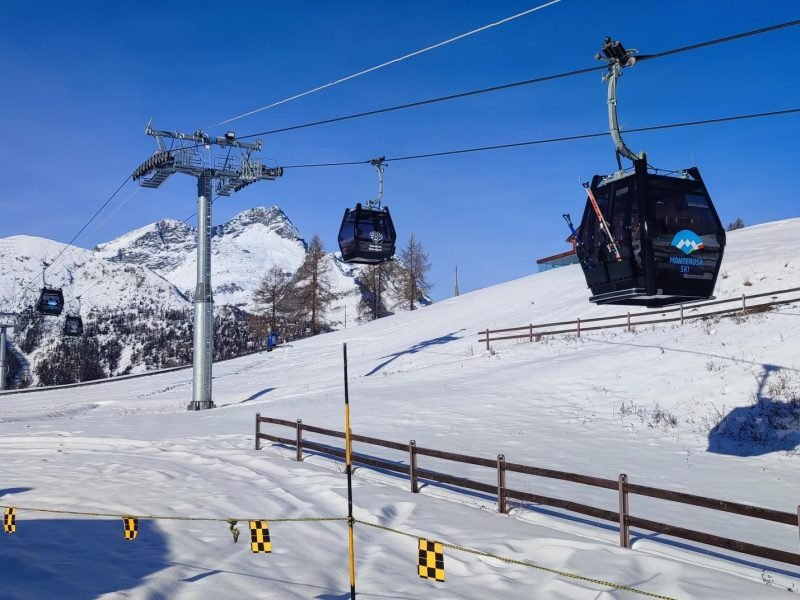
Le Crest preserves an ancient network of connections that bear witness to alpine life and dynamics far beyond the modern era. Today, it is conveniently accessible by cable car from Champoluc; once, however, it could only be reached on foot along a path winding through the forest and ski slope, following the route of a historic mule track. This route, which crosses the Colle del Pinter at 2,777 meters, linked the Val d’Ayas with the Valle di Gressoney, representing a fundamental transversal connection between valleys, used for commercial, pastoral, and military exchanges. It was only in 1948 that Le Crest was equipped with electricity and saw the erection of the Chapel of Maria Auxilium Christianorum, symbolizing the slow but steady progress of this mountain community. The Val d’Ayas and the surrounding valleys, with their numerous passes and cols, embody the complex interconnection of alpine routes, where the mountains do not isolate but rather unite territories and cultures. Historians such as W. A. B. Coolidge have emphasized how alpine passes are human creations, traced to overcome hostile nature and promote commerce, defense, and daily life. Over the centuries, from the Savoyard military to nineteenth-century British geographers and alpinists, these trails have been explored and enhanced, becoming vital arteries of an intricate mountain system, rich in history and human relationships. The vestiges of these ancient connections, now hiking trails, allow us to relive the web of contacts that have always defined alpine identity.