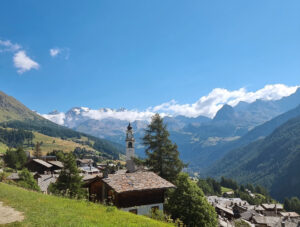
It includes two hamlets, Lo Fratchéi-Damón and Lo Fratchéi-Dézeut (“Above” and “Below”), and belongs, together with Saint-Jacques-des-Allemands and the other villages, to the area known as La Borna or La Bora.
It had a mill and an oven and possessed a mixed school which, lacking sufficient income, often forced children to attend the one in nearby Saint-Jacques.
The Chapel of Saint Roch was commissioned in 1653 by the will of J.-Claude Frachey (1620–1667), the first missionary from the Aosta Valley. Originally dedicated to Saint Claude and later to Saint Roch, the French saint protector against the plague, which also struck the Val d’Ayas heavily in 1630, it was restored in 1837 by the local inhabitants under the initiative of the parish priest of Ayas, François Victor Amé Dandrès (1791–1866).
In 1930, Le Frachey was chosen as the ideal location for one of the first historic hotels in the upper Val d’Ayas, the Monte Cervino or “Lo Servìn,” as it is still called. The building, constructed at that time entirely of stone, lime, sand, and wood, served as a summer holiday destination for mountaineers eager for adventure among the perpetual snows, as well as for noble families who stayed there for entire months, preceded by rows of trunks. Nearly a century has passed since then, and the hotel, renovated several times, still preserves the austere stone silhouette that has always characterized it.
The village, still today a popular departure and arrival point for renowned high-altitude excursions, offers, from its ancient fountain, the excellent fresh water of the Valley.
A short distance from here begins the modern funicular to Alpe Ciarcerio (Alpage de Charcérioz or, in patois, Tcharchério), inaugurated in 2010 and open to summer and winter tourism.
On some beams, the construction date and religious symbols are still preserved, such as the trigram IHS (Jesus, Iesus Hominum Salvator). A devotional fresco depicting the Holy Trinity (a widespread theme in Ayas due to the presence of the confraternity of the same name) was painted on the valley-facing façade of a large building dating back to 1732, now completely restored.
Following the paved lane, you reach the ancient communal oven, now back in operation and lit on special occasions.