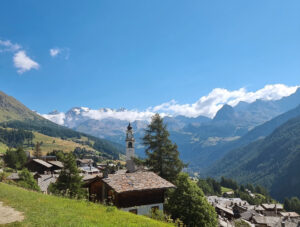
Together, they seem to settle in a way that follows the winding contour lines of the terrain and achieves the best orientation toward the sun.
In ancient documents, these place names appear only after the 17th century, since in earlier times there were only a few scattered houses on the narrow flat strips of land, and the area was considered merely a “Cantone” called “Ultra Aquam,” meaning beyond the bank of the Evançon stream.
In 1257, together with the villages of Pilaz and Magnéchoulaz, the communities of Ultra Aquam obtained as a fief from the local Lords a vast forest stretching from Corbet to Pilaz on the left orographic side of the Evançon, the so-called “bois noirs.” The enfeoffment was later confirmed in 1402. This was the first step toward a reorganization of the territory with the establishment of isolated farms, the nucleus of the future villages, traces of which remain today above all in the rascards (some of which still have the construction date carved into the beams) and in the communal ovens.
Meytéres is simply a cluster of houses connected by a bridge to the road running along the Evançon toward Périasc. At its entrance stands the Chapel of Saint Bartholomew, built in 1937 to serve this group of villages after, as Canon Brunod recounts, the older chapel of the same name in Le Cornu had fallen into ruin and was demolished. Saint Bartholomew, apostle and martyr, preacher of the Gospel in Mesopotamia and India, is traditionally depicted carrying the mantle of his own skin over his arms, together with a knife and a book. Patron saint of butchers, tanners, and bookbinders, he is celebrated on the patronal feast day of August 24.