1.821 meters
Mascognaz Mahcogna
Les Fusines Li Fejeune – 1.700 m
Blanchard Biantchart – 1.724 m
Rovinal Rovénal – 1.709 m
Praz-Sec Pra-Sec – 1.700 m
Les Péyoz Li Péyo – 1.725 m
Les Droles Li Drole – 1.757 m
Bernosin Bernozìn – 1.750 m
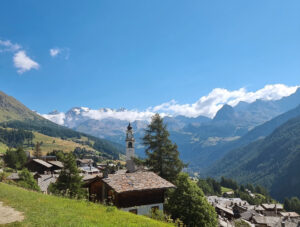
A monumental Swiss pine (stone pine, aroula in patois), the symbolic tree much loved by the sabotiers also for its aesthetic qualities thanks to its particularly decorative knots, towers at the entrance to the village of Mascognaz (Mahcogna in patois).
This small yet important settlement, nestled at the entrance to the valley of the same name branching off from the main valley, where electricity only arrived in 1962, has always remained among the permanently inhabited high-altitude locations.
Since the Middle Ages, it was a settlement area for Walser populations (coming from Valais), who left traces in place names such as li vaile, from the German Wald (forest).
Mentioned as an alpine pasture in 1323 in the will of Ebalo di Challant, it appears to have been inhabited since 1404 and then developed over the following centuries with its large rascards featuring broad sloping roofs and sturdy stone houses grouped around narrow lanes. Until the first half of the 20th century, the village, which had two mills, a bread oven, a school already active in 1844, and a chapel dedicated to Saint Gratus, Bishop of Aosta, was self-sufficient and based on a subsistence agricultural and pastoral economy.
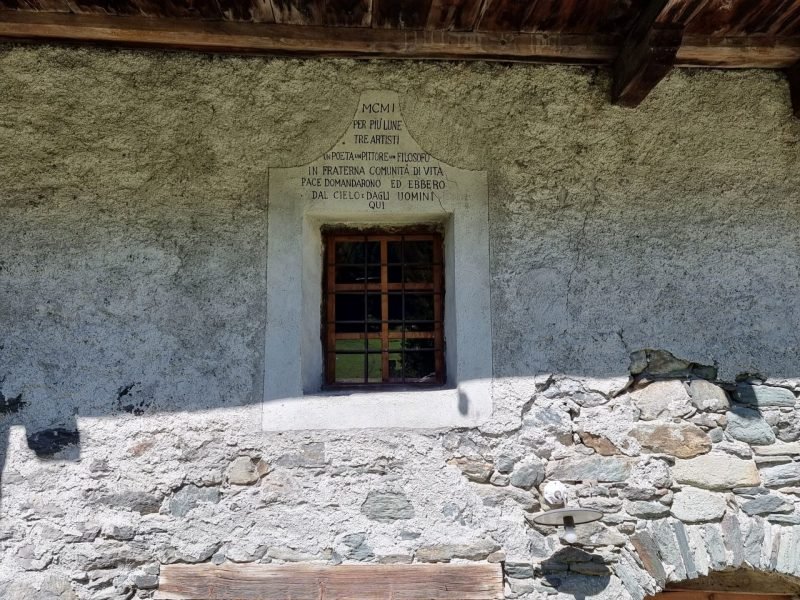
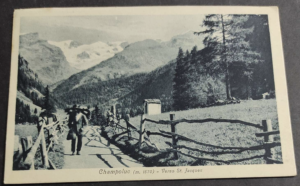
In this oasis of peace and contemplation, particularly loved by the cultural elite of the time, especially from Piedmont, groups of artists and intellectuals repeatedly returned to spend the summer, such as the poet Francesco Pastonchi (1874–1953), the painter Bertino Falchetti (1878–1951), and the “philosopher” Arrigo Frusta (1875–1965), commemorated by an inscription still visible on the façade of a stone house from the first half of the 17th century.
The gradual abandonment that took place between the First and Second World Wars in search of better opportunities and services, together with the lack of speculative tourism development due to the remoteness of the place, “froze” the village in the condition it was in, making Mascognaz, inhabited for centuries by the same family groups, a rare example of socio-economic culture unchanged since its foundation and a highly important historical testimony.
This peculiarity attracted the interest of the scientific community, and in 1965 Mascognaz became the subject of the first university-level studies, which later led to the careful restoration of the ancient structures.

Map of Mascognaz
Casa Fosson
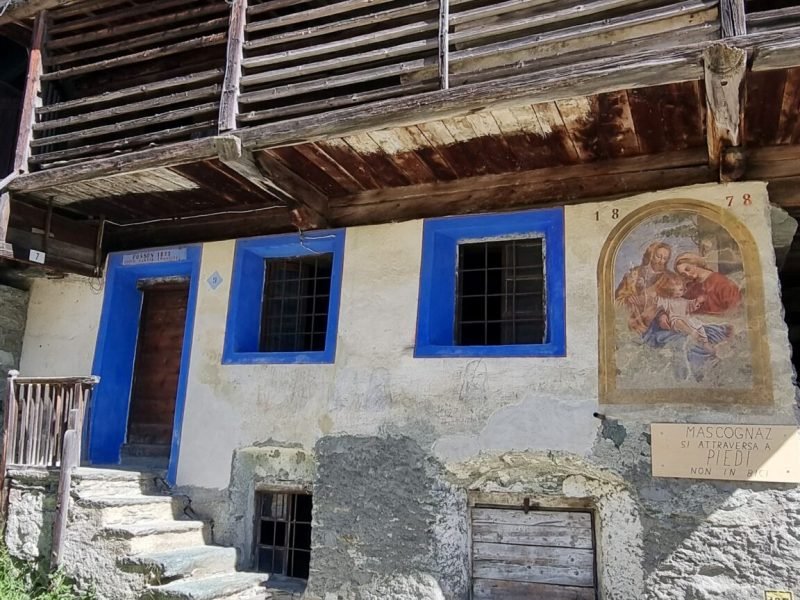
Casa Fosson houses a refined fresco created in 1878 by the artist Franz Curta, depicting a Holy Family immersed in an atmosphere of profound devotion and serenity. The scene is enclosed within a painted frame, the upper part of which opens into an elegant semicircle, imparting a sense of harmony and continuity to the composition. The Madonna, dressed in purple and wrapped in a blue mantle, gently inclines her head towards the Child, who lies upon her knees clad in a pristine white garment, his arms outstretched in a gesture of blessing that conveys protection and grace. Beside them, Saint Joseph is distinguished by the sobriety of his burnished attire; in his right hand he holds a lily stem, a symbol of purity and chastity, while his attentive gaze is directed towards the Child, underscoring his paternal and protective role. This fresco, besides bearing witness to Curta’s mastery in rendering sacred figures with delicacy and vividness, represents a significant example of nineteenth-century religious art, wherein the iconographic tradition merges with meticulous attention to chromatic and compositional detail.

Casa Favre
Casa Favre stands as an authentic refuge for the cultural elite who, at the turn of the nineteenth and twentieth centuries, chose the mountains of Ayas as a place of inspiration and summer retreat. On its façade is an inscription commemorating three prominent figures connected to this corner of the Aosta Valley: Francesco Pastonchi, a late nineteenth-century poet renowned for his intense and reflective verses; Alberto Falchetti, a painter who masterfully captured alpine light and landscapes with vibrant brushstrokes; and Arrigo Frusta, a journalist and intellectual hailed as a “philosopher” for the depth of his cultural analyses. These illustrious guests bear witness to how Casa Favre was not merely a residence but a crossroads of ideas and creativity, set within a natural environment that nourished the artistic and literary output of an entire generation. The dwelling is distinguished by its traditional Valdostan architecture, featuring stone and wood elements that harmoniously engage with the surrounding landscape, imparting an intimate and secluded atmosphere. This place thus embodies not only the history of a family but also a significant chapter in the cultural life of Ayas, where art, poetry, and philosophy converged under the sign of the mountain and its precious tranquility.

Chapel of San Grato
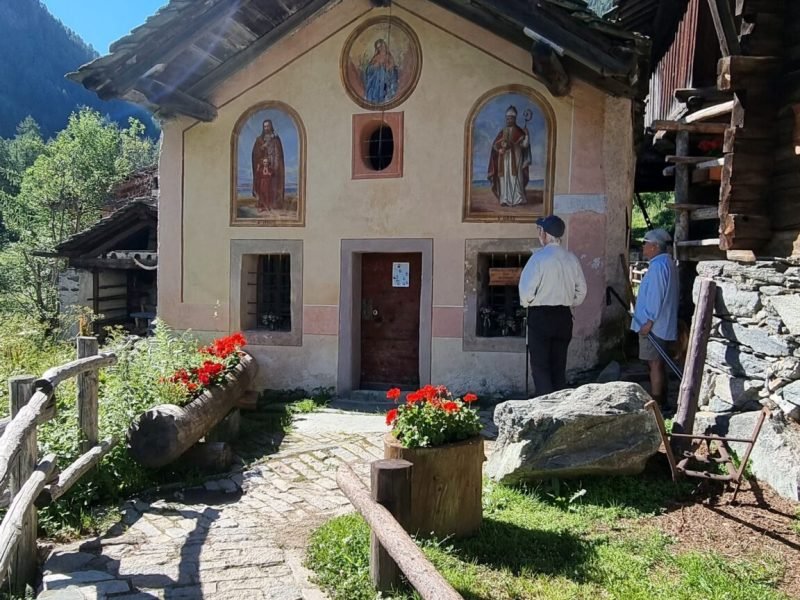
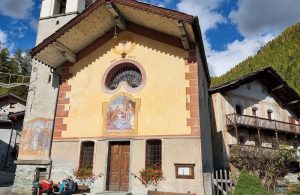
The Chapel of San Grato, although lacking a definitive founding date, bears on its ridge beam the inscription of 1769 alongside the IHS trigram, a symbol of Christ. This small yet significant structure, typical of the rural chapels of the Aosta Valley, was restored in the mid-nineteenth century thanks to the efforts of the parish priest François Victor Amé Dandrès, a prominent figure also noted for his support of local education: as early as 1844, he allocated 15 lire annually for the village teacher, and in 1866, Bishop Jans authorized the use of 600 lire from the chapel’s assets to establish a school fund. The façade is adorned with frescoes by the Valdostan painter Franz Curta, depicting at the center the Virgin crowned with flowers, with the Holy Spirit descending in the form of a dove, a symbol of peace and divine grace. To the left of the Virgin stands Saint Joseph, holding the characteristic lily, emblem of purity, and the Child Jesus displaying the Sacred Heart, a reminder of divine love. On the right rises the figure of Saint Grato, bishop and patron of Aosta, known since the fifth century for protecting the countryside from storms; he holds in his right hand the head of the Baptist on a platter, symbolizing martyrdom, and in his left the pastoral staff, a sign of his spiritual authority. This chapel, therefore, is not only a place of devotion but also a precious witness to the religious and social history of the valley.