Ayas
Traditional dress
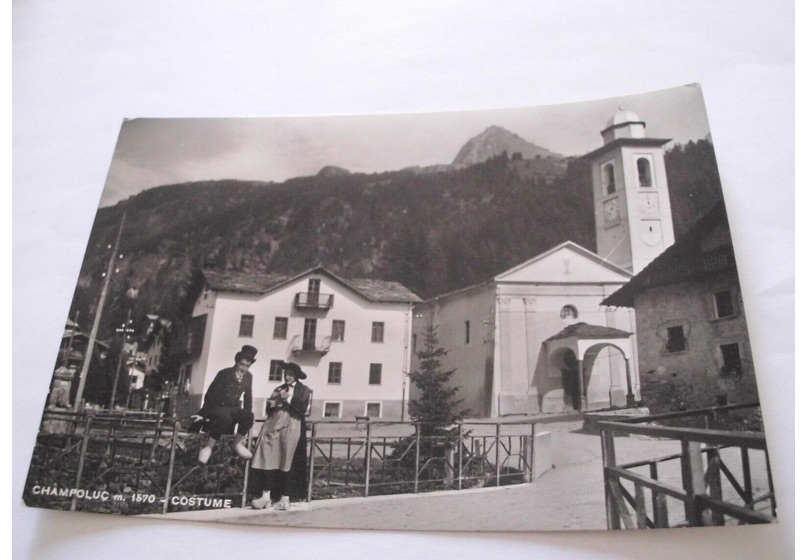
When we speak of traditional costumes today, we tend to think of clothing with a primarily folkloric function that not only the valley inhabitants but also holidaymakers wear on special occasions and festivals to keep the traditions of the past alive.
In reality, its origins are to be found in traditional folk clothing, considered by ethnographers and anthropologists as a true form of communication based on a code of belonging to a community, and a personal indicator of economic and social information.
To reconstruct folk clothing, archival sources such as marriage contracts and wills are invaluable. These documents, especially for more remote eras from which material is rarely preserved, provide us with not only the linguistic terms used for the garments but also their evolution, the types of fabric used, and their provenance.
Interesting information on the clothing of the Val d’Ayas population also comes from the accounts of 19th-century English travelers, such as the engraver James Godby and the Reverend Samuel William King, who crossed the valley in 1855 with his wife Emma, and according to whom “… the women and their tasteful clothes were very neat, and they wear a wide-brimmed hat and men’s high-collared shirts.”
In 1911, on the occasion of the fiftieth anniversary of the Unification of Italy, a large ethnographic exhibition was held in Rome to represent the Italian people and cultures—an important occasion for the study of the history of Italian folk costume. Clothes and accessories from Val d’Ayas were chosen to represent the Evançon community (a male and a female outfit, both for festivities, used in the first half of the 19th century) as a testimony to remote and more archaic mountain areas, less open to novelties.
It was only after the mid-19th century, when clothing—for centuries a distinguishing element between the folk and aristocratic worlds—became an element of prestige in the bourgeois world, that the folk world also evolved and assimilated new elements with its own rhythms and forms. In the Aosta Valley, we thus witness a phenomenon of overlapping styles: on one hand, the colorful and multifaceted folk world; on the other, the rising rural bourgeoisie which, having erased and unified color and eliminated superfluous decoration, manifested its class superiority through the accuracy of the cut and the cleanliness of the garment.
The local costume of the valley is well described by one of Ayas’ historical memories, the teacher Rosina Obert (1893-1989), and its hallmark is the drap, a coarse and rough hand-loomed cloth.
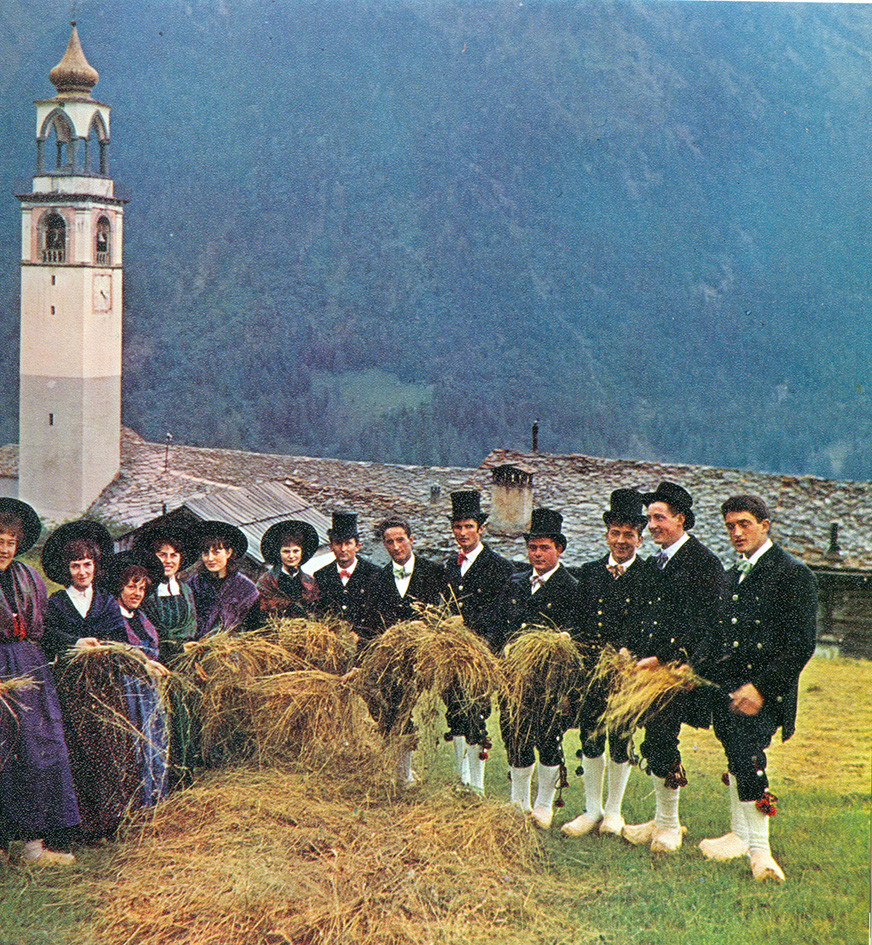
This is how teacher Obert describes the male costume: “The trousers have a waistband with a vertical opening on the front covered by the patt (flap); both the opening and the flap are closed by silver hemispherical buttons; the fastening at the knee consists of two golden buttons and sections of brown cotton ribbon. The waistcoat, which has a brown linen back tightened by a belt with a buckle, features a V-neckline with lapels on the front, three faux pockets with flaps, and a double-breasted fastening. The jacket, characterized by a tailcoat style with the two fronts ending at the waist and the back descending in two tails, has a collar with lapels, sleeves with high cuffs closed by golden buttons, two faux pockets on the hips, and a double-breasted fastening. The costume is then equipped with a linen shirt-front with a pointed collar, a black silk neckerchief used as a tie, and two headpieces: a soft black knitted cotton cap and a black felt hat. The hat has a wide brim and a crown adorned with a tall black velvet ribbon that forms a bow at the side.”
The whole outfit was completed by wool socks (grey calf-high and white soles) knitted with characteristic Ayas decorative motifs, to be worn with sabots. A top hat was also worn as headwear, but for work, a home-made Phrygian cap was used, sometimes dyed pomegranate, turquoise, or purple. The shirt is white, made of hemp or a hemp-cotton blend, and a variously colored neckerchief—floral or checked—is used as a tie. As with the male costume, the female one also has variations, perhaps due to different eras, with personalized details mainly regarding decorative elements.
Come per il costume maschile, anche quello femminile non manca di varianti, forse dovute a epoche diverse, con dettagli personalizzati, riguardanti soprattutto gli elementi decorativi.
According to teacher Obert, the female dress was rather graceless in shape, stout, and sober in color. The skirt for brides and solemnities was made of fine black or turquoise fabric, while the more common one was made of coarse wool, spun and woven at home. At the bottom of the skirt, on the inside, there was a hem of about ten centimeters of variously colored cloth, mostly green or red. The bodice consisted of a hemp frame with broomcorn or raffia ribbing, covered in fabric similar to that of the skirt. Over it, a bolero was worn—a small buttonless jacket of the same fabric as the skirt. The more precious apron, made of percale cotton with floral designs, was held on the chest by two pins or two hooks attached to the bodice shoulder straps and tied at the waist by a ribbon. The shoulder shawl, made of silk with two corners crossed on the chest and fixed to the apron ribbon, had brightly colored fringes for festivities and was made of blue percale with white or multi-colored decorations for other days. The hat, with a wide brim adorned with velvet or wool ribbons, was tied under the chin with a brightly colored silk ribbon. A cap (berretta) was worn under the hat.
The costume was completed by long white hand-knitted wool stockings and sabots. Around the neck, a black ribbon served as a tie, featuring a silver heart and a crucifix.
The traditional costume is worn today by the folk group Li Tsoque d’Ayas (The Sabots of Ayas), founded in 1934.
Bibliography
Various Authors, Ayas. Storia, usi, costumi e tradizioni della valle, Edizioni Società Guide Champoluc-Ayas, 1968
Various Authors, La terra degli Challant. Genti e Paesi della Comunità Montana dell’Evançon, a cura di S.Favre e D.Vicquéry, Comunità Montana Evançon, Musumeci Editore, Aosta, 1998
S.W.King, Le valli italiane delle Alpi Pennine, Zeisciu, Magenta, 2008
S.Favre, Ayas. Antropologia di un territorio. Luoghi, leggende, storie, fatti, Priuli & Verlucca editori, 2020