
Soapstone
Of great economic value to the mountain communities of the Aosta Valley, the production of soapstone cookware – a type of household pottery particularly suited to cooking polenta and soups and to food storage – has a tradition stretching back centuries, owing to the presence of numerous quarries and artisan workshops that were active from late antiquity (4th century) through to the Middle Ages (13th century).
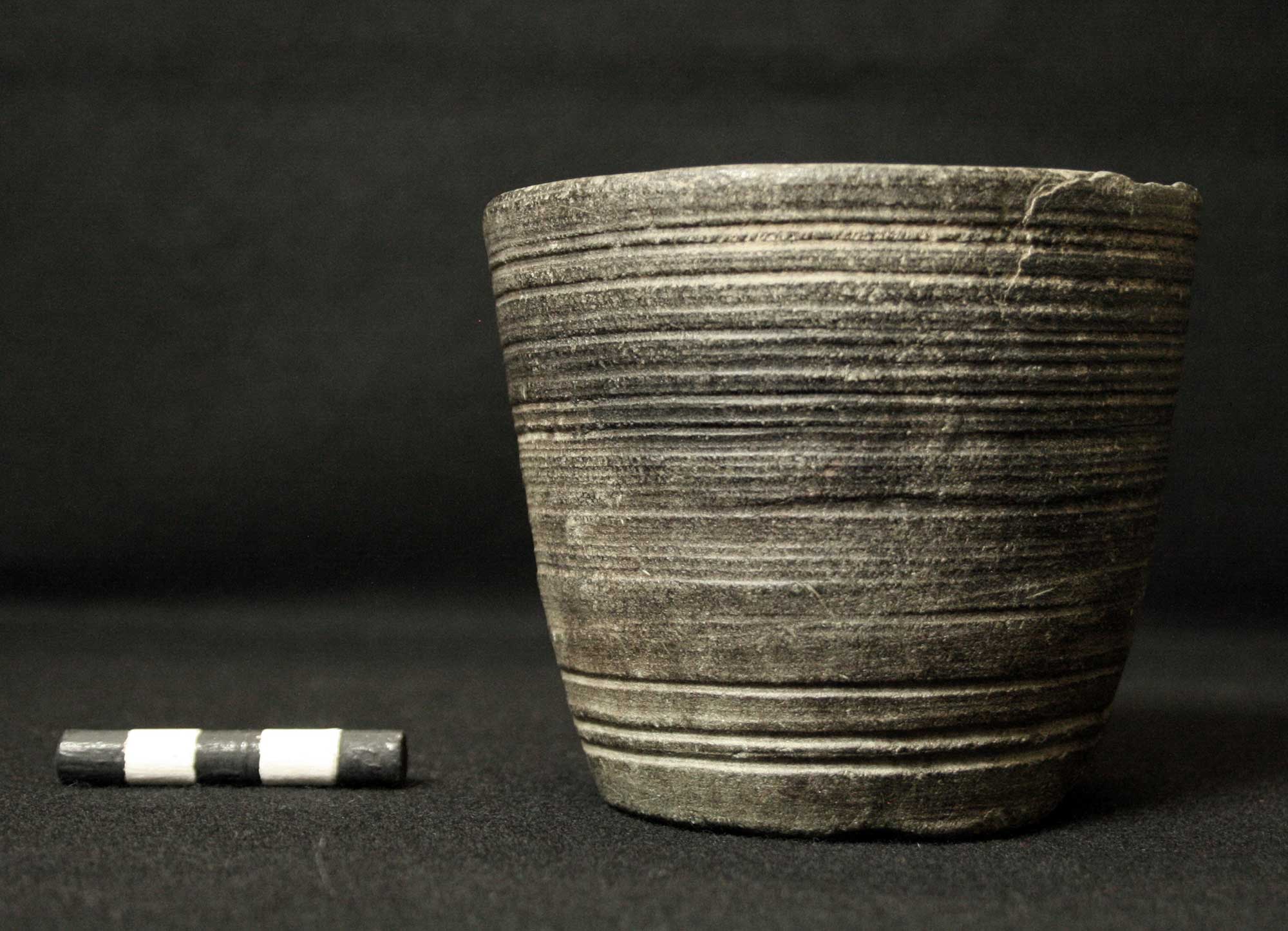
An important source of income and testimony to a vitality and productive energy rarely found in other territorial contexts of north-western Italy, the soapstone ‘phenomenon’ in the Aosta Valley can be traced back to a simple, well-localised economic and productive structure — almost microregional in character — that succeeded in establishing itself within long-distance markets and for a long time played a significant role within commercial circuits, reaching as far as the southern stretches of both the Tyrrhenian and Adriatic coastlines.
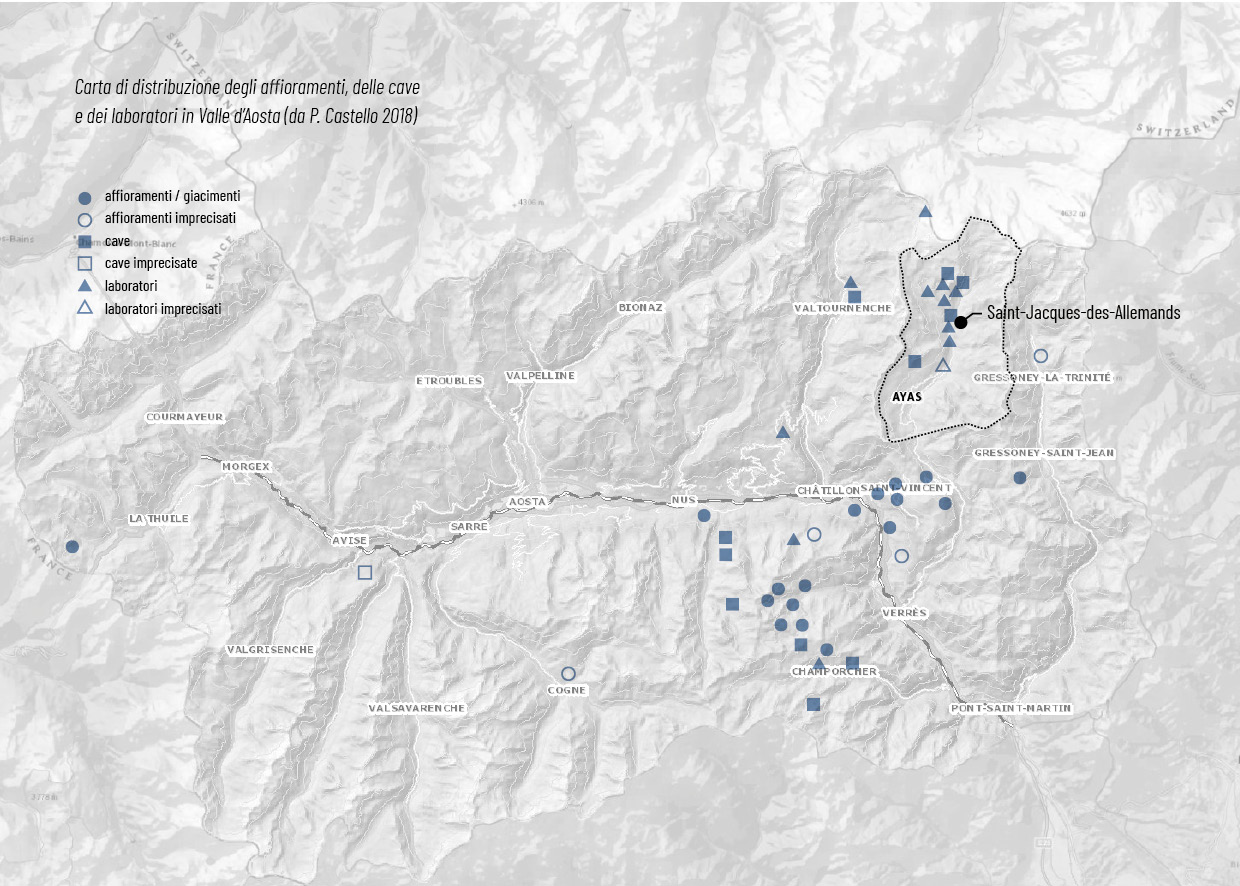
The production workshops identified and documented to date through the presence of turning waste are located near the extraction sites and have been found at altitudes approaching 2,500 metres. While the rich documentation of working debris confirms — if only through sheer numbers — that certain localities, such as Les Fusines at Saint-Jacques-des-Allemands in the Val d’Ayas (alongside other sites in Valmeriana or in the Vallone di Saint-Marcel and Champorcher), constituted production centres of considerable importance, the picture that is emerging is one of significant extraction activity in all the valleys where outcroppings of this particular rock formation appear. The continual new discoveries demonstrate that quarries were exploited wherever the opportunity arose.
While the earliest known evidence of a turning workshop in the Aosta Valley currently dates to 1347 in the Valle di Champorcher, the presence of turned fragments in all the stratigraphic deposits investigated in the region from late Roman times onwards demonstrates that the activity, albeit with fluctuating fortunes, was always flourishing and that the workshops never ceased to exist.
Mineralogical composition
The term “pietra ollare” — literally ‘pot stone’ (pera douça in patois) — does not identify a mineral as such, but rather a product category of stone vessels of various shapes and sizes, the ‘olle’, made on a hydraulic lathe and used as cooking pots and storage containers thanks to their thermodynamic properties (resistance to fire and heat retention) and organoleptic qualities (flavours are not altered).
The soapstones of the Aosta Valley consist of rocks of varying mineral composition originating from the oceanic crust and formed in very remote geological eras (2–3 billion years ago) as a result of an Alpine-type metamorphic process. Among these, the ophiolites belonging to the so-called “Piedmontese zone of calcareous schists with green stones” are particularly prominent, which is why the deposits, the distribution area of the quarries, and the workshops are concentrated in the central-eastern sector of the Aosta Valley. The category ‘soapstone’ thus encompasses several lithotypes (rocks of varying compositions), including chlorite schists and talc schists, which were most extensively used in the production of vessels.
Defining the journey of the stone from quarry to workshop to finished product — whether used locally or traded — is not always straightforward: the object, which is often found in fragmentary form in archaeological excavations or as a furnishing in private homes, or again as an architectural element or antique piece, generally does not display characteristics clear enough to trace it back to a specific workshop and from there to a particular quarry. The lithotypes are often very similar to one another, with the exception of the soapstone from the quarries of Saint-Jacques-des-Allemands in the Val d’Ayas, composed of coarse-grained chlorite schists with frequent garnets.
The particular thermodynamic properties of soapstone make it a rock of many qualities. Soft and easily worked, it offers excellent resistance to temperature fluctuations and, once heat has been absorbed, tends to release it very slowly. Its low porosity limits the absorption of liquids and ensures that the flavour of food is not altered during cooking.
These characteristics meant that production was primarily directed towards the making of truncated-cone shaped vessels and pans of varying diameter and height, accompanied by their corresponding lids.
The extraction of stone blocks at the outcrop sites was followed by their transportation to the turning workshops — a difficult and laborious operation given the weight and bulk of the material and the distances and changes in altitude to be overcome.
For the working of the stone, carried out with the aid of metal chisels, hydraulic lathes were used, characterised by a simple mechanism consisting of a wheel connected to a horizontal wooden element on which the block to be turned was fixed.
In the case of quarries at high altitudes — such as in the Cime Bianche area, between the Valtournenche and the Val d’Ayas — the working of soapstone could take place on site during the alpine pasture season, in the summer months: the necessary equipment and the components for setting up the hydraulic lathe were transported by mule.
Blocks that were not suited to turning were instead shaped using cutting and percussion tools (hammer, chisel, file) to produce, over the centuries, an endless variety of everyday objects: millstones, sinks, vases, windowsills, portals, fountains, fireplaces, finials, stoves, holy water stoups, balustrades, columns, turned rings, drainage pipes, floors, and wall coverings.
In the modern era (between the 18th and 19th centuries), the making of chocolate and coffee cups, glasses, and snuff boxes is even documented, and it is only in recent decades that soapstone has once again crossed regional boundaries in the form of souvenirs at the traditional Sant’Orso Fair, an exhibition of local craftsmanship held every year in Aosta.
Vessels and working waste from the Val d’Ayas, Valtournenche, and Champorcher are preserved at the Regional Archaeological Museum of Aosta and at the Museum of Valdostan Craftsmanship in Fénis.
Features and craftsmanship
The discovery of an ancient artisan workshop in the upper Ayas Valley
In the village of Saint-Jacques-des-Allemands, in the hamlet of Les Fusines (1,700 m above sea level), a fully-fledged workshop for the production of soapstone vessels was identified in 2020.
An emergency archaeological intervention carried out during the laying of a water pipe brought to light a stratigraphic sequence with very substantial deposits of production waste (over a thousand finds) relating to the various stages of the soapstone turning process.
On the basis of the recovered fragments, it was possible to gain insight into certain aspects of the productive technology of this workshop. The distinctive features and characteristics — not only of the raw material but also of the objects produced, for which work could begin from a rough block weighing as much as 40 kg — point to different lithotypes for the soapstone turned at Saint-Jacques. This discovery suggests a supply drawn from a wide extraction area encompassing the entire Vallone delle Cime Bianche, where outcroppings of fine-grained chlorite schists are frequent, along with workshops that turned soapstone even at high altitude (2,400–2,500 m above sea level).
While definitive chronological attributions for the Saint-Jacques workshop are still lacking, the rich documentation of artefacts made from lithotypes very similar to those found in other archaeological investigations throughout the territory of the Aosta Valley would appear to testify to a particular productive vitality and intensity at the craft centres between the 4th and the 7th–8th centuries. The site, given the importance of the find, ranks — not only at a regional but also at a national and transalpine level — as one of the principal contexts for the extraction and working of chlorite schist vessels.
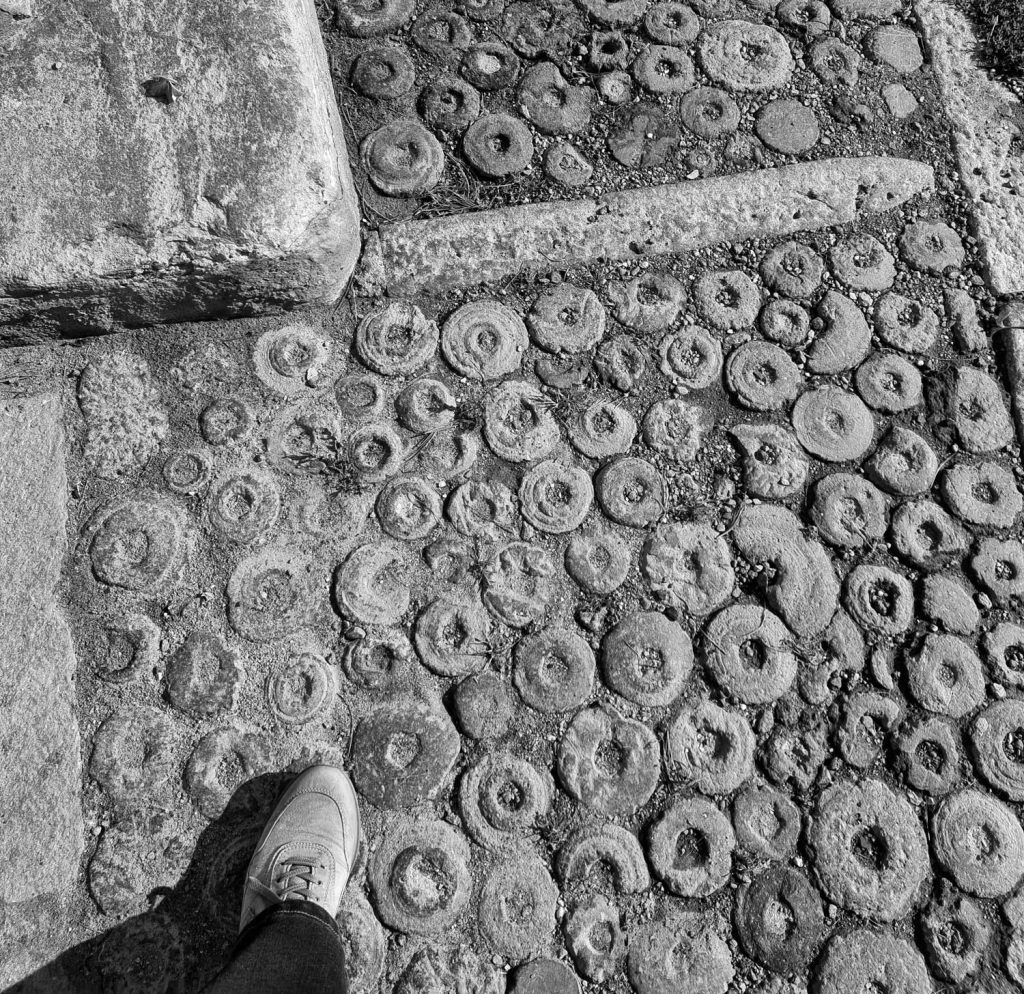
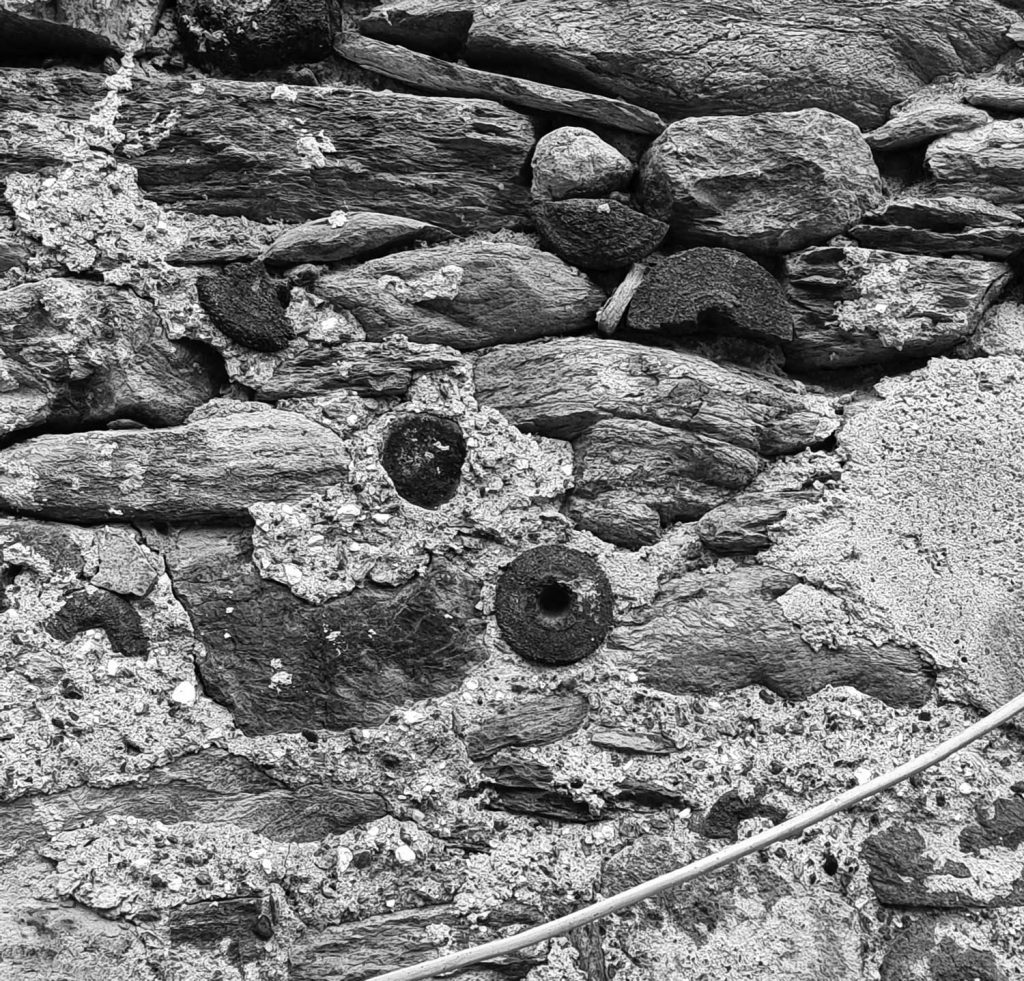
The great abundance of turning waste has furthermore favoured, over the centuries, its reuse in architecture: a phenomenon still clearly visible today in Saint-Jacques-des-Allemands in the walls of houses, in chimney stacks, and in paved surfaces, foremost among them the forecourt of the Chapel of San Giacomo Apostolo.
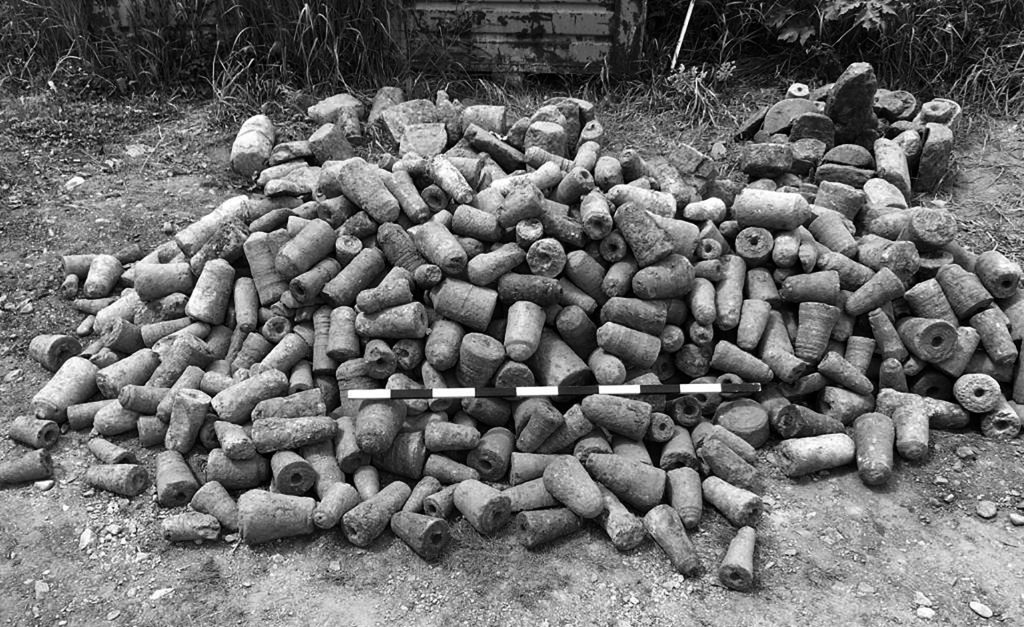
The cones and cylinders of stone constitute the residue (‘core’) of the cavity removed from the vessel during the turning operation and represent the most classic and ‘typical’ archaeological find — the one that defines soapstone working and identifies an ancient workshop. At the time of discovery they are generally found heaped up in the vicinity of the ancient workshops, which in turn are situated not far from the sources of the raw material.
Les Fusines, waste from soapstone processing
To find out more, download the information booklet:
The excavation was funded by the Municipality of Ayas, with the second phase funded by the Superintendency for Cultural Heritage of the Aosta Valley Region Contractor: Intercultura (Davide Casagrande) Scientific director: Gabriele Sartorio Pebble stone specialist: Mauro Cortelazzo.
Bibliography
Cortelazzo, La pietra ollare della Valle d’Aosta. Cave, laboratori e commercio, in “Bulletin d’Études préhistoriques et archéologiques alpines” publié par la Société Valdôtaine de Préhistoire et d’Archéologie, Numéro spécial consacré aux Actes du XIe Colloque sur les Alpes dans l’Antiquité, Champsec / Val de Bagnes / Valais-Suisse, 15–17 septembre 2006 (par les soins de Damien Daudry), XVIII, Aoste 2007
Castello, Cave e laboratori di pietra ollare della Valle d’Aosta in La pietra ollare nelle alpi. Coltivazione e utilizzo nelle zone di provenienza, Atti dei convegni e guida all’escursione (Carcoforo, 11 agosto; Varallo, 8 ottobre; Ossola, 9 ottobre 2016) a cura di R. Fantoni, R. Cerri e P. de Vingo, Sesto Fiorentino 2018, All’Insegna del Giglio, pp. 105–116
Cortelazzo, G. Sartorio, La pietra ollare nell’economia valdostana tra tarda antichità e alto medioevo. Dai laboratori di produzione di Saint-Jacques des Allemands (Ayas) al consumo dei manufatti nel sito di Messigné (Nus), in ISCUM (a cura di), T. Mannoni. Attualità e sviluppi di metodi e idee, Volume 4.1, Sezione 2. Produzioni, Sesto Fiorentino 2021, All’Insegna del Giglio, pp. 161–168
Cortelazzo, Mercanti e tornitori di pietra ollare nei colli Alpini tra la tarda Antichità e l’alto Medioevo, in “Valli unite da colli” a cura di R. Fantoni, R. Cerri, convegno di Varallo Sesia, 18–19 settembre 2021, in corso di stampa