Champoluc
Tourism
Compared to Courmayeur, Gressoney-Saint-Jean and Le Breuil, which had enjoyed tourist and mountaineering prominence at a European level since the mid-19th century, Ayas was slow to take off.
It was only with the construction of the carriage road, begun in 1887 and completed in 1924, that Ayas emerged from its mountain isolation.
To reach it in 1888, one had to hire a mount at the Albergo Italia in Verrès, or from the innkeeper at Brusson, booking in advance. Throughout the entire Val d’Ayas there were only two hotels: the Lion d’Or in Brusson, “recommended for good service, equipped with guides, porters and mounts for excursions,” and the Hôtel des Cimes Blanches at Les Fiéry, a “fine hotel in the Swiss style, run by Monsieur Fausson, where the mountaineer can be sure of finding comfortable refreshment.”
Along the old mule track, it took three and a half hours to reach Brusson, six hours and a quarter to reach Champoluc, and seven hours and three quarters to reach the hotel at Les Fiéry. In 1899, the Guida illustrata della Valle di Challant o d’Ayas by Amé Gorret and Giovanni Varale described the villages of Ayas as characteristic and picturesque, in beautiful settings, but still lacking hotels and inns where hospitality could be found.
Initially frequented by passing hikers engaged in crossings from one pass to another, it soon became one of the most flourishing Alpine resorts for summer stays. Among the first notable visitors were Giuseppe Giacosa, Guido Gozzano, and Edmondo de Amicis.
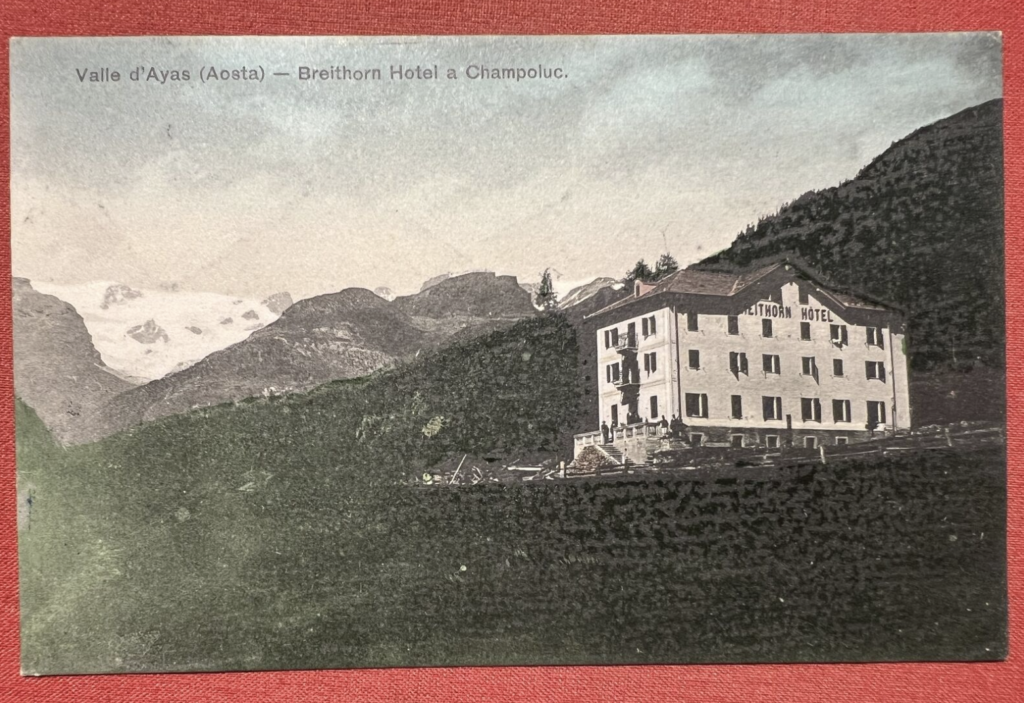
The first hotel in Champoluc, the Breithorn, opened in 1905; the Lyskam in Antagnod in 1907. The first villas of celebrated figures and prominent entrepreneurial families also appeared: Sem Benelli, Storace, Dogliotti, Vitelli, Cravetto, Pinna Pintor, Ferrino, Natta, Vitelli.
After the first competitions for local skiers were organised in the 1920s, the 1930s saw the construction of a large number of hotels get underway. The great potential of the Val d’Ayas for winter stays and sport had by then become unmistakable.
In addition to Brusson and Champoluc, Challand-Saint-Anselme (in the lower valley), Périasc, Antagnod, Le Frachey, Saint-Jacques-des-Allemands, and Les Fiéry became highly popular holiday destinations.
In the picturesque and lively basin of Champoluc, the traveller could now find a post office, telegraph, public telephone, petrol station, hairdresser, pharmacy, first aid, various shops, and the Casa delle Guide. The number of beds on offer was very high. So read the guide by Mario Aldovrandi (La valle di Champoluc) in 1931: “Hôtel Breithorn (photo 1) (100 beds), just outside the hamlet, towards St. Jacques, various annexes, first-class service, garage, tennis, large dining and reading rooms and entertainment hall, splendid view; Hôtel Castore, past the church (100 beds), annex, open all year, first-class service, terrace, garage, tennis, large dining room, reading rooms, private car service for hotel guests (recommended); Albergo Moderno, before entering Champoluc (50 beds), family-style service, splendid view, garage; Albergo Ristorante Testa Grigia, modest, family-style service, terrace, garage; Pensione Favre, before the bridge, guesthouse, home cooking, garage; Caffè Bar Miramonti, near the bridge, elegant meeting place, large terrace, orchestra.”
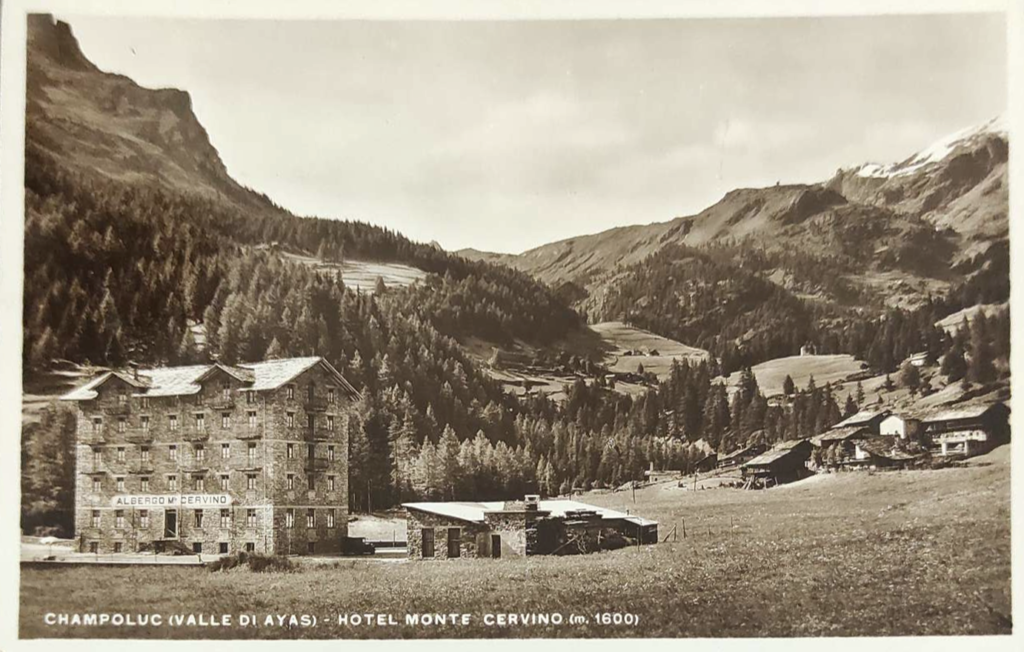
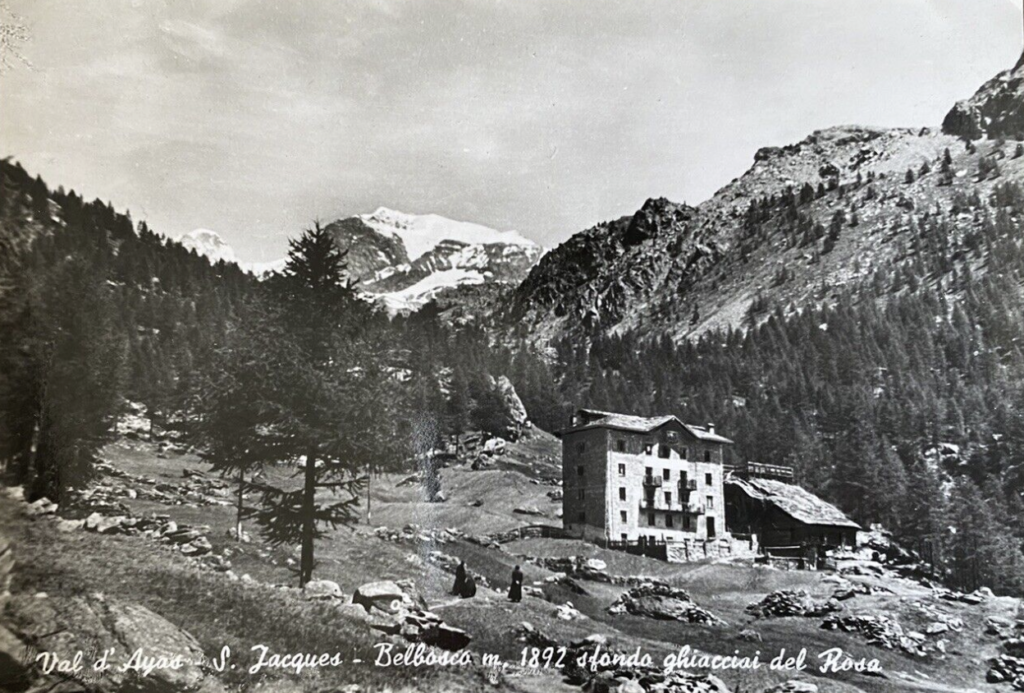
In Antagnod the tourist was welcomed by the Hôtel Lyskamm and the Hôtel Monte Rosa; in Lignod the “brand new” Miravalle; in Le Frachey the Albergo Monte Cervino (photo 2), or ‘Lo Servìn’, as it is still called today; in Saint-Jacques the Alpi Rosa, with 50 rooms, “brand new, recommended,” the Grand Tournalin, and the Pensione Facciabella; in Les Fiéry the Bellavista, with 50 rooms, “annex, large dining room, modern amenities, recommended.” To rent apartments, one simply had to apply to the parish priest.
The growing presence of tourists in both the summer and winter seasons prompted the emergence of a range of tourist services that initially complemented the pre-existing agropastoral economy, which was progressively declining; this new tourism-based offering provided employment and income to what had once been a closed economic system, until it became, directly and indirectly, one of its principal and most dynamic components.
Bibliography
Various Authors, La terra degli Challant. Genti e Paesi della Comunità Montana dell’Evançon, edited by S. Favre and D. Vicquéry, Comunità Montana Evançon, Musumeci Editore, Aosta, 1998