Les Fusines Li Fejeune – 1.700 m Blanchard Biantchart – 1.724 m Rovinal Rovénal – 1.709 m Praz-Sec Pra-Sec – 1.700 m Les Péyoz Li Péyo – 1.725 m Les Droles Li Drole – 1.757 m Bernosin Bernozìn – 1.750 m
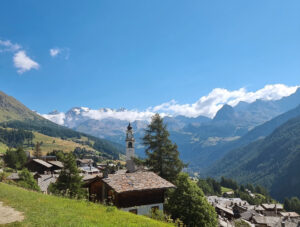
Mandrou (Mandroù in patois) is the highest village on the right orographic side of the Evançon stream, overlooking a highly evocative panorama across the entire upper Val d’Ayas and in particular the peaks rising along the Mascognaz and Bettaforcaz valleys, as well as the northern head of the valley.
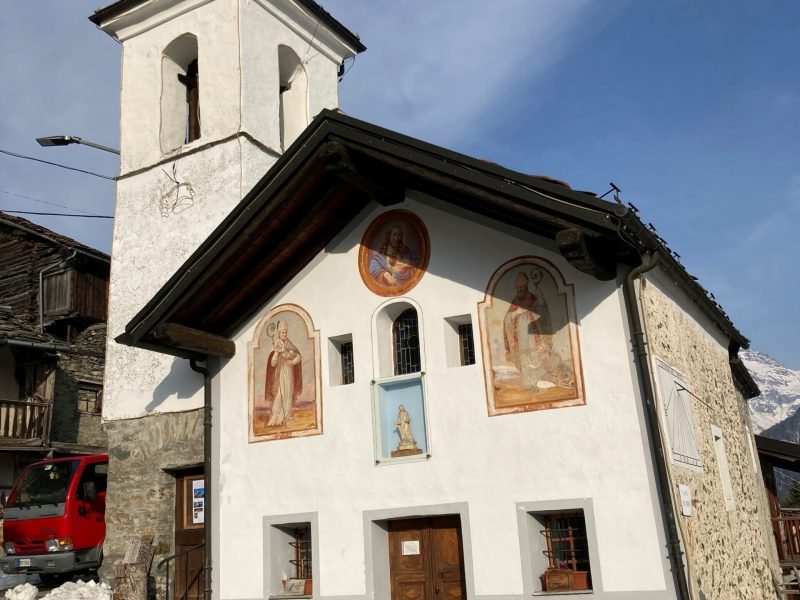
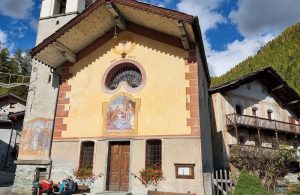
The ancient rascards, surrounded by woods and pastures, adapt themselves to the winding contour lines of the terrain. On the valley side stands the 18th-century Chapel of the Immaculate Conception, whose façade was painted by the well-known Aosta Valley painter Franz Curta, active in the second half of the 19th century. Devotional images depicting the Holy Family can also be seen, while walking through the village, on the walls of important civil houses, such as Casa Brése (painted in 1703) and Casa Obert (the latter bearing the signature of Franz Curta himself, 1876).
In the past, Mandrou was a well-populated village, so much so that in 1808 it felt the need to open a mixed school, drawing funds from the chapel. It also possessed an oven and a mill, demolished in 1968 with the construction of the carriage road.
Among the oldest buildings stands out a large multifunctional house from the second half of the 16th century, entirely built in masonry, with external wooden balconies, according to the architectural model most widespread in the 16th century: stable and cellar covered by stone barrel vaults on the ground floor, living quarters on the first floor, and hayloft and granary in the attic.
Dating instead from 1673 is the so-called “Martin Burgay rascard,” which stands out from the general roofline, taller and more finely finished than the others.
Map of Mandrou
Chapel of the Immaculate Conception
From 1908 to 1911, the family of Alfredo Frassati, founder and director of the Turin newspaper La Stampa, senator of the Kingdom of Italy and of the Italian Republic, and father of the Blessed Pier Giorgio (1901–1925), also spent their holidays at the Bellevue. In 2009, a path bearing his name was dedicated to him, a devotional and spiritual circular route of almost six hours from Saint-Jacques-des-Allemands to Les Fiéry and Alpe Vardaz, from Pian di Tsére to Pian di Verraz Inferiore and then to Résy, returning again to Saint-Jacques.
Contracts for the construction of houses
The Aosta Notarial Archive preserves contracts with work specifications for building works, known as prix-faits, drawn up between the client and the craftsman and usually divided into three parts: the supply of materials, the amount to be paid, and the methods of payment. In these contracts, the masonry part is always considered a building in its own right, sometimes already constructed when the contract with the carpenter is drawn up. For masonry, the height of the walls to be built is specified, while for rascard buildings the height is defined according to the number of ‘tours’, the courses of logs, generally between sixteen and nineteen.