Antagnod
Sabot and Sabotier

The sabot
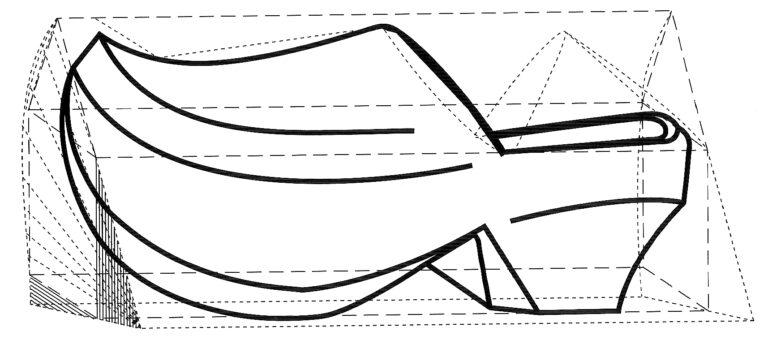
The sabot (tsôque in the patois of Ayas), a sturdy piece of footwear carved from wood, is the product of an ancient craft industry unique to Ayas and forms part of its distinctive identity.
The true date of the first pair of sabot is unknown, but it certainly dates back to very remote times. More reliable information concerns the geographical areas: this footwear, carved from a single piece of wood, was widespread in various parts of Europe (in Belgium and the Netherlands, in the Jura, along the Pyrenees, and in northern France). The shape varied, but the manufacturing technique was probably the same, and their purpose was to provide warm footwear that protected against cold and water and prevented the wearer from sinking into the mud.
In France in 1772, in the Encyclopédie ou Dictionnaire raisonné des sciences, des arts et des métiers, Denis Diderot described the stages of sabot production and the tools used — practically identical to those of the craftsmen of Ayas, the sabotier (tsacolé).
The inhabitants of the Val d’Ayas wore sabot almost exclusively, not out of passing fashion, but out of necessity and practicality. Few people owned shoes (soulier), which were reserved only for special occasions, above all when they had to leave the village on important business. Wealthier women, on the other hand, wore shoes when they went to the djoéi — that is, when making purchases for a wedding — and on the wedding day itself. Children too had their own sabot, tied to their legs with a cord so as not to lose them in the woods and fields.
Women’s sabot had a finer line than men’s, with a higher heel.
The sabotier
According to tradition, the long and laborious manufacture of sabot began in November, after the feast of All Saints, when outdoor work had come to an end and most of the men of Ayas returned to their workshops — often stables — to devote themselves to the trade of sabotier.
To make the work faster and more productive, it was common to work in pairs (travài dévésà), one person handling the interior, the other the exterior. It is said that twelve pairs represented a full day’s work for two men. The craftsmen could also go directly to customers to take measurements, which were established approximately, relying on experience (grôsse, mèdzane and bachtardine). The most suitable wood was the arolla pine (Swiss stone pine), whose dense forests represented an inexhaustible resource, although products in fir and larch were not uncommon.
As a rule, the trade of sabotier was passed down from father to son. The craftsman received the technical knowledge and tools of the trade within the family, remaining an independent worker with his own workshop, selling his goods on the local market or to merchants.
The sabot industry grew rapidly and its product spread throughout the Aosta Valley — also thanks to the annual Sant’Orso fair — reaching, by the end of the 18th century, Piedmont, where this distinctive footwear was particularly well suited to the rice paddies and farms of the Vercelli and Novara areas. The rise in demand meant that, in the following century, the trade of sabotier became predominant over other crafts, such as those of the glove-makers and sawyers, which gradually disappeared. At the beginning of the 20th century, Ayas counted as many as 250 sabotier.
The demand for sabot from Piedmont further strengthened trade between Ayas and the plains, increasing employment and income in the valley, but also leading to the depletion of local forests and a shortage of raw materials — factors that drove a considerable wave of emigration of entire families to other parts of the Aosta Valley and triggered significant socio-cultural processes. To increase production, a certain Borbey, a native of Ayas, even considered resorting to machinery, adapting equipment already in use in France for making sabot with leather uppers. However, the appearance of rubber boots and footwear around the mid-20th century sent the entire supply chain into crisis.
Today, machines can replace part of the work previously done by hand, though the delicate task of hand-finishing remains. To prevent this ancient tradition — which is also part of Ayas’s cultural heritage — from being lost, it must be passed on to younger generations, even if the sabot is no longer a necessity but a fashion, a pleasure, an ornament, a souvenir. In the villages of Ayas, sabot can be seen hanging from balconies and on the façades of houses, or used as flower pots!
The manufacture of the sabot
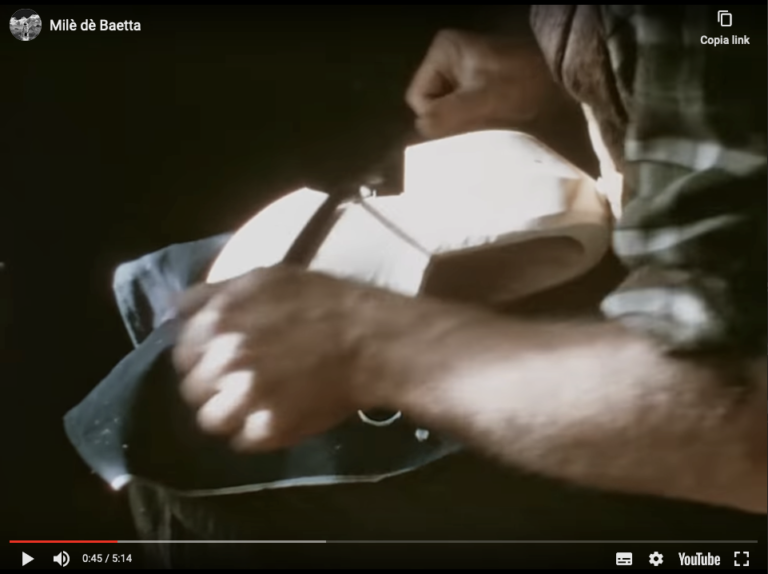
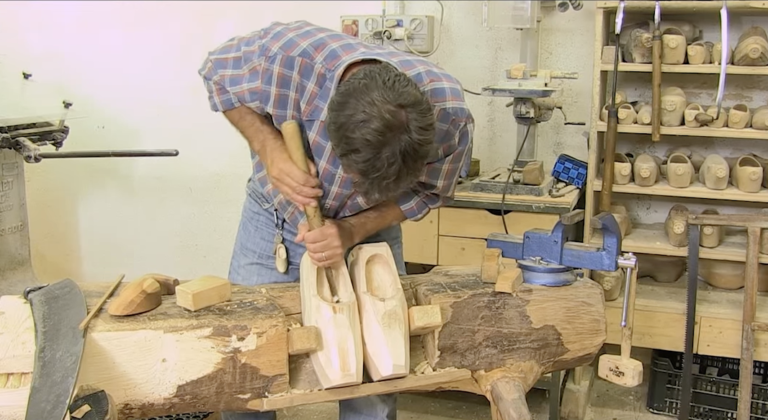
A tree trunk is placed on a sawhorse (cartchôt) and cut into blocks of varying length depending on the size of the sabot to be made. Using an axe (pioula ehquiapéra) and a wooden mallet (mâtsa), the blocks are split (ehquiapà) on a chopping block (tseucón) — an operation requiring two people. The most productive block is one that can be split into four or more pieces. The pieces of wood are then paired, rough-hewn, and squared. On the workbench (banc di tsôque), the outer shape is further modelled using special knives and the form of the sabot is outlined (a step known in patois as échapolà). At the same time, the opening for the foot is shaped (gordjà), with a ruler used to ensure that the upper edge is equidistant from both ends — an essential condition for the sabot to fit well. The hollower (tchavoù) begins work on the interior, hollowing out the sabot with a travéla — a gimlet with a screw tip to which a rotary motion is applied. As this is the easiest part of the work, it is generally entrusted to apprentices. The interior is then finished using a chisel with a leaf-shaped blade (lénguetta). The heel and toe are then shaped using the bench knife. For the exterior of the sabot, the unmistakable two-handled knife (coutél dè dove man) is used — a highly specialised tool that also requires a protective guard (pétsa), a simple piece of wood tied around the waist with a strap, indispensable at this stage when the craftsman holds the piece in place with his knees.
The final step consists of rounding the rim of the opening with a fixed-blade knife (coutel dréit). The sabot are now ready to be worn. Using a pencil (créyón di tsôque), they are numbered according to their size, tied in pairs through a hole, and hung up to dry. To make them more robust and long-lasting, they are reinforced with a wire inserted into the groove around the opening and secured with two small nails at the centre of the heel.
Bibliography
L.Capra, S.Favre, G.Saglio, I sabotier d’Ayas. Mestiere tradizionale di una comunità valdostana, “Quaderni di cultura alpina”, Priuli & Verlucca editori, Aosta, 1995