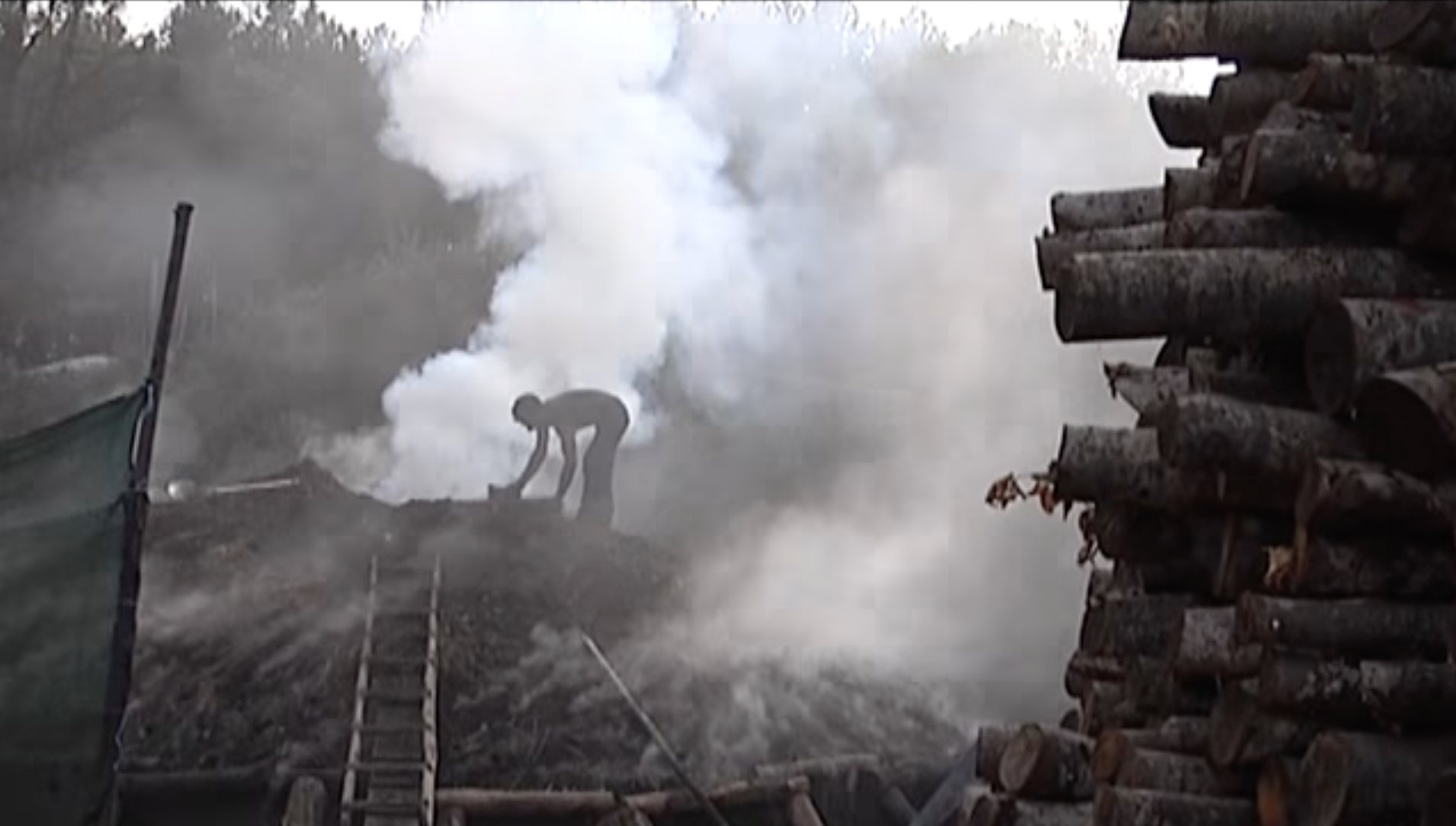
Charcoal kilns were widespread throughout Italy and are regarded as a cultural and ethnographic heritage asset. The website of the Central Institute for the General Catalogue and Documentation features a page with a video documenting their construction.
The Charcoal Kilns
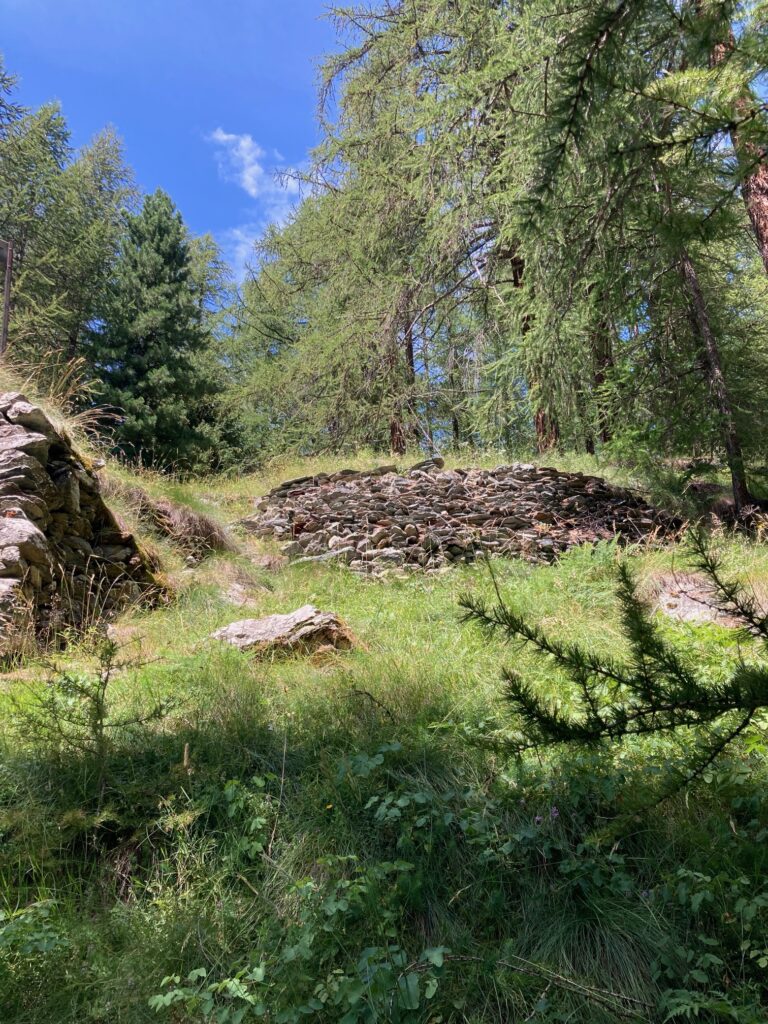
The transformation of wood into charcoal took place in specially built circular wooden structures with a conical covering layered with leaves and earth, known as charcoal kilns (carbonaie), which were set up in numerous locations. The kilns could be built either on flat ground or on sloping terrain, supported in the latter case by dry-stone walls, such as those still visible near the paths in the woodland above Les Fiery.
Les Fiery, the remains of the stone walls of a charcoal kiln
The construction operations of the charcoal kiln were very laborious, and the transformation of wood into charcoal could take up to ten days. Even today, traces of them can still be found at the edges of woods and in clearings.
La Tcharbonéra (the Charcoal Kiln) and Pratcharbón (Pracharbon) are two place names that bear witness to this intense activity in Ayas. In Pracharbon in particular, large quantities of charcoal were produced for use in smelting copper ore extracted from a local mine.
The felling of trees for the charcoal kilns also provided an opportunity to obtain medicinal substances used in folk medicine. Beneath the bark of larch trees, for example, there is a spongy white or yellow film known as pél dè tronc (tree trunk skin) — a dry resin used to treat wounds and remove splinters.
The charcoal produced not only met local needs, but was also loaded onto carts and transported to Verrès, where it was traded across the various municipalities of the Valley.
Bibliography
S.Favre, Ayas. Antropologia di un territorio. Luoghi, leggende, storie, fatti, Priuli & Verlucca editori, 2020