
The consorterie of the Aosta Valley form part of the wider family of so-called national ‘collective estates’, which go by different names in the various Italian regions and are characterised by three elements:
1. A community (the owner of the property) within the local area, generally comprising the inhabitants of one or more villages.
2. A tangible asset, namely land for communal use, understood as a resource that is not only economic but also natural, aesthetic, scenic and cultural (a complete ecosystem). It may be a plot of land used for agricultural, forestry or pastoral purposes, but also a bakery, a mill, a communal dairy, a watercourse…
3. This purpose is the collective use and management of the asset itself, a purpose that goes beyond and transcends the interests of the individual members of the community. This purpose, in turn, confers on the asset the status of public property, with the consequent inalienability, indivisibility and non-prescriptibility of the asset and, in the case of land, its perpetual agricultural, forestry and pastoral use. Collective assets are currently governed by Law No. 168/2017 and are defined as ‘intergenerational’ property.
Although all consorterie have their own distinctive characteristics, they can be divided into two broad categories: uti universi, the oldest and most complex, and uti singoli, the simplest. Some may be a mixture of the two.
In the first type, consortium members do not own the property individually, but as members of the community; consequently, they may neither sell nor bequeath their share of the property. The requirements for becoming a consortium member are generally residence in the case of woodlands, or ownership of private property within the consortium’s territory in the case of pastures; as regards the use of pastures, entitlement lies with those who own land used for grazing, in proportion to the number of animals kept on that land.
In the second type, the members each hold an individual share of the benefits (e.g. grazing rights) of the undivided property and may dispose of it freely, either by selling it or bequeathing it. In these cases, as the assets generally consist of pastures, the shares are measured in terms of the number of head of cattle that a member is entitled to send to graze: one head is equivalent to one cow, two feet to half, one foot to a quarter, and one hoof to an eighth.
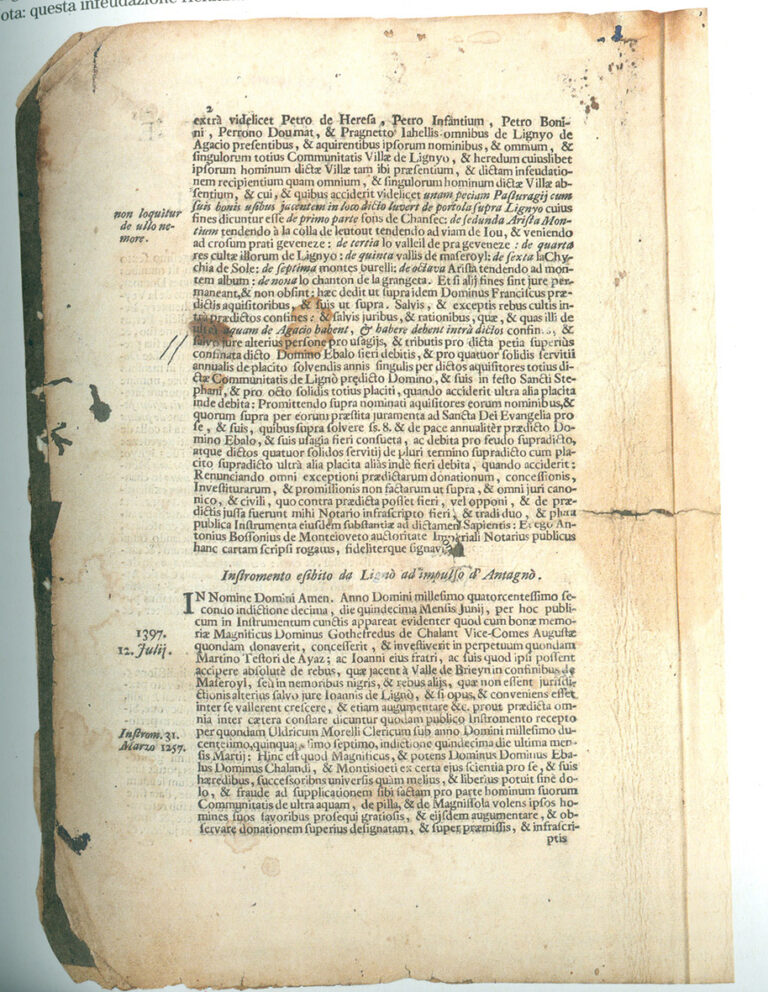
Lacking a clear legal framework, the consorteries have often been at the centre of disputes and quarrels that have sometimes dragged on for centuries. A notable example is the dispute between the villages of Antagnod and Lignod over ownership of the Pracharbon woods, which lasted five centuries (1397–1897) and was finally settled by an arbitration ruling. With the abolition of feudal taxes in 1786, the consorterie of Ayas were freed from the interference of the Lords of Challant and, whilst retaining their identity, came under the administration of the municipality.
The consortia of the Aosta Valley were at risk of being completely dissolved following the enactment of Law No. 1766 of 1927, the so-called ‘Law on Civic Usufruct’. In some cases, their assets were transferred to the municipalities and the consortia were abolished; in others, the members were given the right to divide up the consortia’s assets. The consortia of Ayas, however, strenuously defended their prerogatives, continuing to manage their assets even though legal representation remained entrusted to the municipalities.
These are the major districts of Ayas, listed by area:
The Magneaz-Champoluc-Rovinal area, covering approximately 9,200,000 square metres, including over 3,100,000 square metres in the Vasé area, transferred from the Region to the municipality in 2009;
The Pilaz-Périasc-Mentenc area, covering approximately 6,760,000 square metres;
The Lignod estate, covering approximately 6,398,000 square metres;
The Antagnod estate, covering approximately 4,400,000 square metres (including the so-called Arp common grazing land);
The Bisous development, covering approximately 1,669,000 square metres;
The Antagnod-Lignod Forestry Consortium, which is a specific consortium comprising the woodlands located within the consortium territories of Antagnod and Lignod.
Following the enactment of Law No. 168 of 2017 on ‘Provisions on collective domains’, the regulatory framework governing collective property has undergone a profound change, and consortia, as collective domains, are finally recognised as ‘intergenerational property’ that is inalienable, indivisible, and cannot be acquired by adverse possession, and is designated for agricultural, forestry and pastoral use.
With the recent Law No. 19 of 1 August 2022, which incorporates the principles of national Law No. 168/2017, the Region has established a comprehensive framework for consortia, stipulating, amongst other things, in an innovative manner that the consortium regime “also applies, where compatible, to other forms of collective ownership treated as equivalent to them”, such as, for example, the old village schools, bakeries and mills of general interest, communal dairies, etc.; just as it may apply, on a voluntary basis, to immovable property of an agricultural, forestry, pastoral and environmental nature, intended for the pursuit of collective interests. The consortium institution is therefore not only preserved and protected, but also strengthened and expanded.
Despite the trials and controversies they have faced, these consortia still represent today, in addition to a heritage of inestimable value, a legacy of culture and wisdom, of prerogatives and indispensable values, to be preserved and passed on to future generations. Ultimately, they represent a bulwark against speculation and a guarantee for the protection and preservation of the landscape and the environment.
For a broader overview of the various community institutions, and in particular of the consortia, associations and everything relating to the ‘common goods’ not only of Ayas but also of the Aosta Valley, visit the website www.autonomiebenicomuni.eu
Bibliography
R.Louvin, Un bene comune tra pubblico e privato. Profili giuridici del fenomeno delle consorterie valdostane, Aosta, 2012
S.Favre, Ayas. Antropologia di un territorio. Luoghi, leggende, storie, fatti, Priuli & Verlucca editori, 2020
S.Rollandin, Le consorterie di Ayas ed altri frammenti di storia locale, Association Valdôtaine Archives Sonores, Saint-Christophe, 2021