1.821 meters

Mascognaz Mahcogna

Les Fusines Li Fejeune – 1.700 m
Blanchard Biantchart – 1.724 m
Rovinal Rovénal – 1.709 m
Praz-Sec Pra-Sec – 1.700 m
Les Péyoz Li Péyo – 1.725 m
Les Droles Li Drole – 1.757 m
Bernosin Bernozìn – 1.750 m

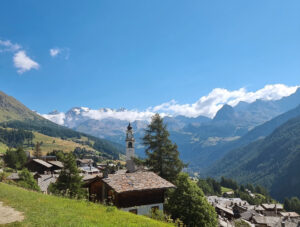
A monumental Swiss pine (stone pine, aroula in patois), the symbolic tree much loved by the sabotiers also for its aesthetic qualities thanks to its particularly decorative knots, towers at the entrance to the village of Mascognaz (Mahcogna in patois).


This small yet important settlement, nestled at the entrance to the valley of the same name branching off from the main valley, where electricity only arrived in 1962, has always remained among the permanently inhabited high-altitude locations.

Since the Middle Ages, it was a settlement area for Walser populations (coming from Valais), who left traces in place names such as li vaile, from the German Wald (forest).

Mentioned as an alpine pasture in 1323 in the will of Ebalo di Challant, it appears to have been inhabited since 1404 and then developed over the following centuries with its large rascards featuring broad sloping roofs and sturdy stone houses grouped around narrow lanes. Until the first half of the 20th century, the village, which had two mills, a bread oven, a school already active in 1844, and a chapel dedicated to Saint Gratus, Bishop of Aosta, was self-sufficient and based on a subsistence agricultural and pastoral economy.

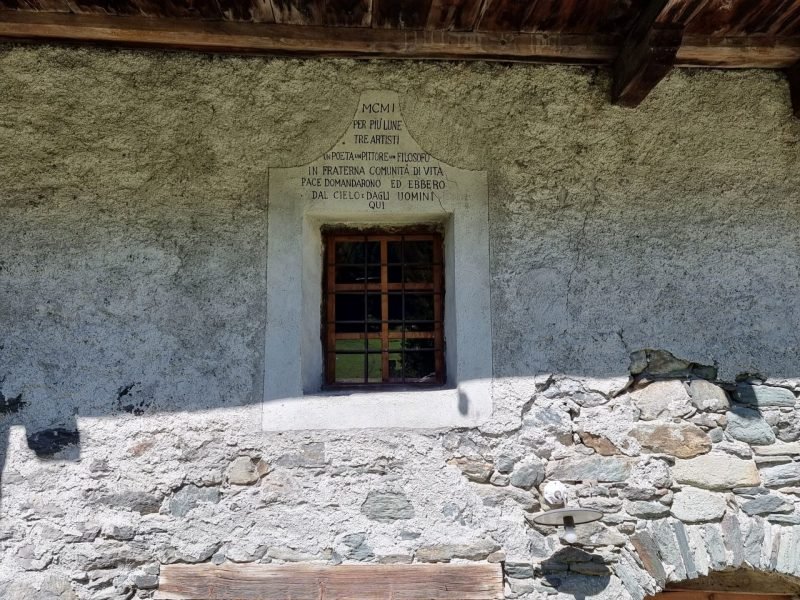
In this oasis of peace and contemplation, particularly loved by the cultural elite of the time, especially from Piedmont, groups of artists and intellectuals repeatedly returned to spend the summer, such as the poet Francesco Pastonchi (1874–1953), the painter Bertino Falchetti (1878–1951), and the “philosopher” Arrigo Frusta (1875–1965), commemorated by an inscription still visible on the façade of a stone house from the first half of the 17th century.

The gradual abandonment that took place between the First and Second World Wars in search of better opportunities and services, together with the lack of speculative tourism development due to the remoteness of the place, “froze” the village in the condition it was in, making Mascognaz, inhabited for centuries by the same family groups, a rare example of socio-economic culture unchanged since its foundation and a highly important historical testimony.

This peculiarity attracted the interest of the scientific community, and in 1965 Mascognaz became the subject of the first university-level studies, which later led to the careful restoration of the ancient structures.

Map of Mascognaz

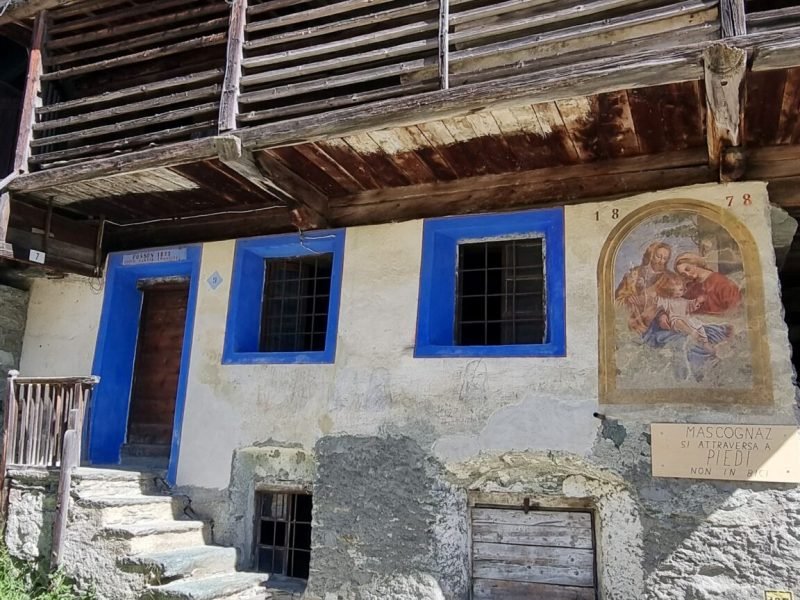
Fosson House

The painting of the Holy Family, frescoed by Franz Curta in 1878, is set within a painted frame with a semicircular top. The Virgin Mary, dressed in purple and cloaked in blue, leans her head towards the Child, who lies on her lap, dressed in white and with his arms outstretched in a gesture of blessing. Saint Joseph, dressed and cloaked in brown, holds a lily stem in his right hand and looks towards the Child.

Favre House

On the façade of Casa Favre there is an inscription referring to three artists who loved to spend their summers in Ayas, as did the cultural elite of the time: the poet Francesco Pastonchi (1874–1953), the painter Alberto Falchetti (1878–1951) and the ‘philosopher’ and journalist Arrigo Frusta (1875–1965) MCMI FOR MANY A MOON THREE ARTISTS A POET, A PAINTER, A PHILOSOPHER IN FRATERNAL COMMUNITY OF LIFE PEACE THEY SOUGHT AND RECEIVED FROM HEAVEN AND FROM MEN HERE

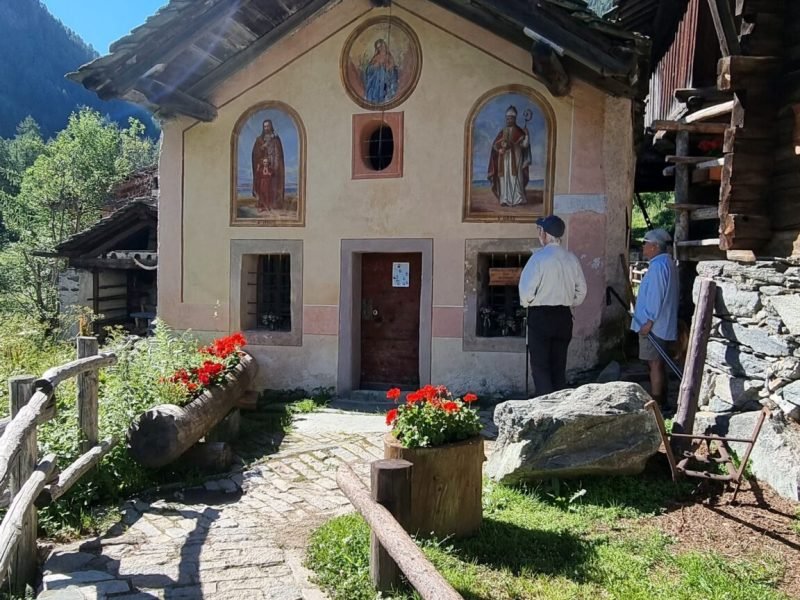
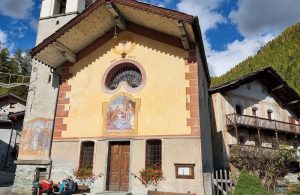
Chapel of San Grato

The date 1769 is carved into the ridge beam alongside the trigram IHS (Jesus), although the year of its foundation is unknown. Like many other chapels in the valley, it underwent restoration work in the mid-19th century at the behest of the parish priest of Ayas, François Victor Amé Dandrès (1791–1866). An authoritative historical source notes that, as early as 1844, he provided 15 lire a year to pay the village teacher and that on 26 February 1866 Bishop Jans authorised the withdrawal of 600 lire from the chapel’s assets to form a fund for the school. The frescoes on the façade are the work of the Aosta Valley painter Franz Curta (1827–1881): in the centre, in a tondo, is the Virgin crowned with flowers, upon whom the Holy Spirit descends in the form of a mystical dove; on the left-hand side, Saint Joseph, dressed in brown, holding a lily in his right hand, and before him, the Child showing the Sacred Heart to the faithful; on the right-hand side, Saint Gratus, bishop and patron saint of Aosta, protector of harvests from storms, who lived in the 5th century, holds the head of John the Baptist on a platter in his right hand and the bishop’s crozier in his left.

Mascognaz, a place of transit and connection

The numerous passes along the ridges of the Val d’Ayas, the Valle del Lys, the Valsesia and the western Biella valleys formed the cornerstones of a complex system for the intra-Alpine movement of goods and people, complementing the major trans-Alpine routes. In the Mascognaz valley, close to the watershed with the neighbouring Lys Valley, natural passes and mountain passes through the high mountain ranges have always facilitated the connection with the village of Gressoney-Saint-Jean. At the head of the valley itself, the Mascognaz Pass (2,859 m) and the Colle di Valfredda or Colle di Valeille (2,805 m) are passable. Heading up the northern slope, however, is the Colle Pinter (2,777 m), which is easier and more popular, whilst, heading south, is the Colle Palasinaz, which allows for a descent into the area of the lakes of the same name. From here, the Lys Valley is reached via Colle Valnera (2,676 m), Bocchetta di Eclou (2,526 m) and the historic Colle Ranzola (2,170 m), a key transit point along the route formed by the Col de Joux to the west towards the central Aosta Valley and Colle Valdobbia to the east towards Valsesia.

You might also be interested in: