Les Fusines Li Fejeune – 1.700 m Blanchard Biantchart – 1.724 m Rovinal Rovénal – 1.709 m Praz-Sec Pra-Sec – 1.700 m Les Péyoz Li Péyo – 1.725 m Les Droles Li Drole – 1.757 m Bernosin Bernozìn – 1.750 m
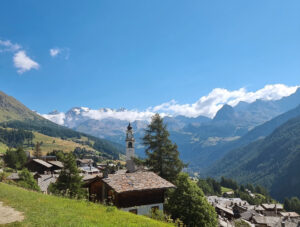
Mentioned in historical documents as an alpine pasture in 1323, the village of Cunéaz (Quenéa in patois) appears to have been permanently inhabited around 1376. Located at the entrance to the valley of the same name, along the mule track connecting the Val d’Ayas and the Gressoney Valley through the Pinter Pass, the small original settlement expanded in the 14th century during the migration of Walser populations from the Valais who settled in the valley. Historical evidence of their presence can still be found today in several place names of Germanic origin.
In the 18th century, Cunéaz was a large and densely populated center, reaching more than one hundred inhabitants, distributed among sixteen families who lived year-round at such a high altitude. The village, completely self-sufficient, was organized into three districts: the Véla (from the Latin villa, country house), which was the actual center, the Cazà, below, and the Oberdó (from the Germanic term Ober Dorf, upper village), above. It had a mill and three ovens, two of them private and one communal (restored in 1990).
The existence of a mixed school as early as 1783 is also documented, largely funded by the ancient Chapel of Saint Lawrence (17th century).
Alongside the more recent stone masonry houses (18th–19th century), numerous ancient rascards still stand, one of which even dates back to the 15th century, a precious historical and architectural heritage now protected through careful restoration and renovation work.
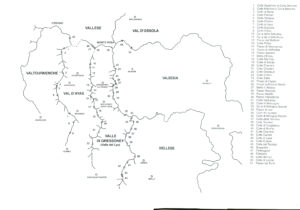
Map of Cunéaz
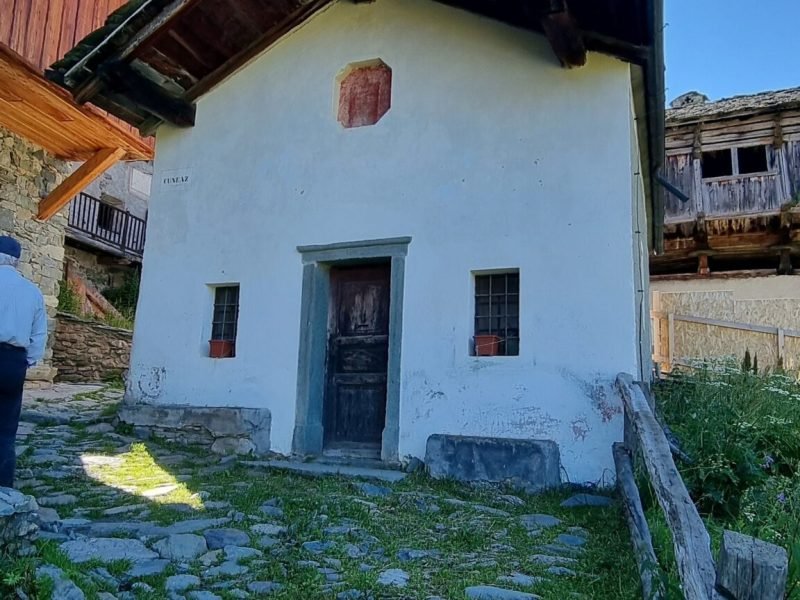
Chapel of San Lorenzo
The small white chapel at the entrance to the village was built in the 17th century and dedicated to Saint Lawrence. It once housed a precious 15th-century silver chalice, crafted using chiselling and repoussé techniques and decorated with enamel. According to an old local tradition, it was donated by a woman who had married in France at the time of the Revolution and who, having found the object amongst discarded rubbish, took it with her on her return to Cunéaz.
A special event
It is said that on 15 September 1799, as many as 2,000 soldiers from a French contingent heading for Gressoney to bypass Bard Fort spent the night in Cunéaz. They ate seven cows and an ox, all the bread and cheese in the village, and the hens they managed to catch.